July 16th, 2026 | 07:20 CEST
Antimony as the "Invisible Glue" of Industry and Defence: Antimony Resources, BASF, and Lockheed Martin
Created and published on behalf of Antimony Resources Corp.
A relatively unknown semimetal that for decades remained in the shadow of the commodity giants has suddenly emerged as the strategic nerve center of Western industry. Antimony is essential for flame retardants in electronics, heat-resistant cables in fighter jets, and modern battery systems; without this material, key technologies cannot be produced. When China effectively halted exports in December 2024, this catapulted the price of antimony skyward in a very short time and exposed a critical dependency. As the West searches for alternative supply chains, established corporations are coming under pressure. That is why today we are taking a closer look at the up-and-coming antimony producer Antimony Resources, the industrial conglomerate BASF, and the defense contractor Lockheed Martin.
time to read: 4 minutes | Author: Armin Schulz
ISIN: ANTIMONY RESOURCES CORP | CA0369271014 | CSE: ATMY , OTCQB: ATMYF , BASF SE NA O.N. | DE000BASF111 , LOCKHEED MARTIN DL 1 | US5398301094
Table of contents:
Author

Armin Schulz
Born in Mönchengladbach, he studied business administration in the Netherlands. In the course of his studies he came into contact with the stock exchange for the first time. He has more than 25 years of experience in stock market business.
Tag cloud
Shares cloud
Antimony Resources: The Raw Material That Is Needed
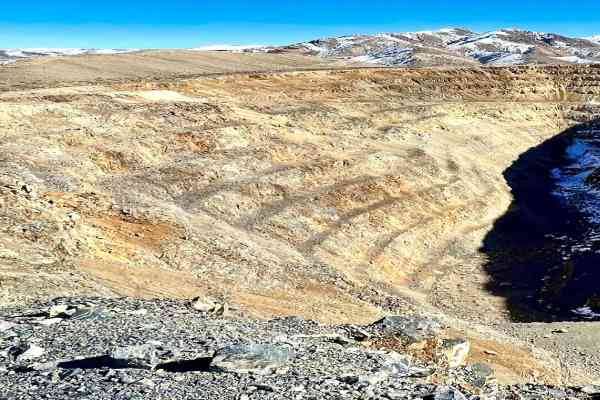
Dependence on Chinese antimony is a growing problem for Western militaries. Antimony Resources has now brought John M. Melkon on board, a man who could open doors to the US military. The former Special Forces officer and current professor at the US Military Academy at West Point brings excellent connections to the table. His task is to underscore the strategic importance of the Bald Hill project for national security and to secure financing opportunities through the Export-Import Bank.
The latest results from the Main Zone look promising. 13.14% antimony in drill hole BH-26-20, 16.65% and even 33.4% in hole BH-26-25, with average thicknesses of 4.5 m. Drilling operations aim to extend mineralization to the south and north and to fill data gaps for the resource estimate planned for the fall. At the same time, exploration is underway in the newly discovered zones. In the Central Zone, initial grab samples yielded averages of 4.5% antimony over a strike length of 170 m, with peak values of 20.5%. The South Zone even yielded an average of 19.5%, with values as high as 44.2%.
Systematic analysis of the drilling data has revealed an additional discovery: gold. In over 45 drill holes in the Main Zone, an average of 1.14 g/t over 2.56 m was identified, including highs of 1.88 g/t over just under 5 m. The gold mineralization occurs both in association with antimony and as a standalone occurrence. The use of artificial intelligence in data analysis is clearly paying off here. Between 15,000 and 18,000 m of drilling is scheduled for the coming months, and the first resource estimate is expected in the fall. SRK is supporting the process. Market conditions remain favourable, as the price of antimony has quadrupled within two years. Analysts at GBC see a price target of CAD 3.00. The share is currently trading at just CAD 0.48.
BASF: Between Commodity Risk and a Billion-Dollar Transformation
To understand BASF, one must also be aware of its hidden dependencies. A semimetal called antimony has become surprisingly relevant to the company. The material is used in plastics production as a flame retardant synergist, particularly in the high-performance polymers Ultramid and Ultradur for e-mobility and electronics. The problem is that China largely controls the refining capacity. Although BASF is working on antimony-free alternatives, in the short term the company remains dependent on a raw material whose supply chains are considered increasingly fragile. A shortage could severely impact margins in the plastics division.
The major portfolio restructuring is taking shape. The sale of the coatings division to Carlyle for EUR 7.7 billion is nearing completion; the European Commission has given the green light. BASF expects a cash inflow of around EUR 5.8 billion. The money is urgently needed, as the company has committed to returning at least EUR 12 billion to shareholders by 2028. The annual dividend of at least EUR 2.25 provides a reliable baseline. But the real question is whether the company can use the proceeds to drive forward its "CoreShift" efficiency program, which aims to reduce fixed costs in its core business by 20% by 2029.
The most ambitious project is still ahead. A partial IPO of the agricultural division is expected, with valuations ranging from EUR 20 to 30 billion, according to Handelsblatt. Currently, the entire BASF Group has a market capitalization of around EUR 42 billion. Should this valuation of the agricultural division hold, the market could face a fundamental revaluation of the remaining industrial business. However, the timeline remains uncertain. The divided opinions among analysts, ranging from "Outperform" to "Underweight", show just how divided experts are regarding the value of the restructuring. The share is currently trading at around EUR 48.57.
Lockheed Martin: Record Orders and Operational Challenges
For Lockheed Martin, antimony is far more than just an exotic raw material. It is the invisible backbone of numerous key technologies, from heat-resistant cable insulation in the F-35 to armour-piercing ammunition alloys and infrared sensors in guidance systems. The semimetal is found in virtually all of the defence contractor's relevant product lines. Lockheed Martin is responding by seeking alternative sources of supply and recycling solutions, but the technical hurdles are considerable.
The summer of 2026 brought Lockheed Martin an unprecedented surge in orders. At the end of June, the Pentagon awarded a contract worth up to USD 35 billion to quadruple THAAD production to 400 interceptor missiles annually, followed by a USD 3 billion deal for the Sentinel A4 radar system. The NATO summit in Ankara provided additional momentum. Together with Rheinmetall, the company will manufacture ATACMS missiles in Germany for the first time, while a Patriot maintenance facility is being built in Europe. The USD 3.45 billion acquisition of Ultra Maritime also strengthens the underwater business segment. All in all, Lockheed Martin secured orders totaling well over USD 38 billion within a few weeks.
In the first quarter of 2026, earnings per share of USD 6.44 fell significantly short of expectations, while segment operating profit shrank to 10.1%. Costs related to the F-16 program, delivery bottlenecks with the C-130, and delays with Sikorsky helicopters amounted to USD 240 million. Free cash flow turned negative at USD 291 million due to an ERP system migration. Analysts are therefore divided. Citi raised its price target to USD 582, while Jefferies lowered it to USD 575. All eyes are now on July 23, when Lockheed Martin will report its half-year results. The company itself has so far reaffirmed its full-year outlook despite all the headwinds. The share is currently trading at around USD 514.99.
The antimony crisis is turning out to be a wake-up call for the West. While Antimony Resources is emerging as a beacon of hope for North American supply with promising drilling results, BASF is struggling to maintain operational stability amid raw material risks in its plastics division and a billion-dollar restructuring. Lockheed Martin, meanwhile, is posting record orders but is suffering from supply bottlenecks and operational setbacks. The raw material reveals a systemic vulnerability that, in the medium term, can only be resolved through new mining projects and technological alternatives. Until then, this dependence remains a strategic Sword of Damocles.
Conflict of interest
Pursuant to §85 of the German Securities Trading Act (WpHG), we point out that Apaton Finance GmbH as well as partners, authors or employees of Apaton Finance GmbH (hereinafter referred to as "Relevant Persons") currently hold or hold shares or other financial instruments of the aforementioned companies and speculate on their price developments. In this respect, they intend to sell or acquire shares or other financial instruments of the companies (hereinafter each referred to as a "Transaction"). Transactions may thereby influence the respective price of the shares or other financial instruments of the Company.
In this respect, there is a concrete conflict of interest in the reporting on the companies.
In addition, Apaton Finance GmbH is active in the context of the preparation and publication of the reporting in paid contractual relationships.
For this reason, there is also a concrete conflict of interest.
The above information on existing conflicts of interest applies to all types and forms of publication used by Apaton Finance GmbH for publications on companies.
Risk notice
Apaton Finance GmbH offers editors, agencies and companies the opportunity to publish commentaries, interviews, summaries, news and the like on news.financial. These contents are exclusively for the information of the readers and do not represent any call to action or recommendations, neither explicitly nor implicitly they are to be understood as an assurance of possible price developments. The contents do not replace individual expert investment advice and do not constitute an offer to sell the discussed share(s) or other financial instruments, nor an invitation to buy or sell such.
The content is expressly not a financial analysis, but a journalistic or advertising text. Readers or users who make investment decisions or carry out transactions on the basis of the information provided here do so entirely at their own risk. No contractual relationship is established between Apaton Finance GmbH and its readers or the users of its offers, as our information only refers to the company and not to the investment decision of the reader or user.
The acquisition of financial instruments involves high risks, which can lead to the total loss of the invested capital. The information published by Apaton Finance GmbH and its authors is based on careful research. Nevertheless, no liability is assumed for financial losses or a content-related guarantee for the topicality, correctness, appropriateness and completeness of the content provided here. Please also note our Terms of use.