September 1st, 2026 | 07:25 CEST
AI: The 180-Degree Turn for Performance Cars! VW, Porsche, BYD and Standard Uranium in Focus
It has finally happened – AI is permeating every aspect of life. This is creating many new conditions, including for stock market investors. One example is the automotive sector: for the traditional auto industry to survive, a fundamental U-turn is essential. Whilst long-established brands such as VW and Porsche have dominated for decades thanks to their mastery of classic mechanical engineering and driving dynamics, AI is now rapidly shifting the core of value creation to the software level. The modern vehicle is rapidly evolving from a mechanical means of transport into a rolling supercomputer. This is evident in the disruptive strategy of Chinese tech giants such as BYD. Not only does the company control around 75% of its vertical supply chain, including its own AI chips, but its integrated AI architecture is also completely breaking down the traditional barriers between the powertrain, the cockpit and the driver-assistance systems. This transformation is putting German premium manufacturers under enormous pressure in terms of time and margins, as the iterative addition of individual control units appears too sluggish and inflexible compared to BYD's centralized AI 'brain'. For investors, this creates a highly dynamic environment. It is worth taking a closer look.
time to read: 7 minutes | Author: André Will-Laudien
ISIN: VOLKSWAGEN AG VZO O.N. | DE0007664039 , PORSCHE AUTOM.HLDG VZO | DE000PAH0038 , BYD CO. LTD H YC 1 | CNE100000296 , STANDARD URANIUM LTD. | CA85422Q8487 | TSXV: STND , OTCQB: STTDF
Table of contents:
Author

André Will-Laudien
Born in Munich, he first studied economics and graduated in business administration at the Ludwig-Maximilians-University in 1995. As he was involved with the stock market at a very early stage, he now has more than 30 years of experience in the capital markets.
Tag cloud
Shares cloud
VW and Porsche: The Continental Defence Strategy Costs Time and Money
The strategic realignment in the global automotive market is in full swing. A closer look at the partnership between the Volkswagen Group and Rivian, for example, reveals the enormous economic significance of this transatlantic alliance, which is conceived as a USD 5 billion tech bet. Recent quarterly figures impressively demonstrate that this joint venture has already become a key revenue driver for the still loss-making US manufacturer Rivian, as it has recorded significant inflows in the software and services segment. Whilst Volkswagen is using the billion-dollar investment primarily as a technological shortcut to secure the future of its all-electric premium models, the fresh capital from Wolfsburg is providing noticeable relief for Rivian's costly operational business.
The exclusive subsidiary Porsche, under its new boss Michael Leiter, is still struggling to find the right direction in the electric vehicle market, as the former flagship model, the Taycan, suffered a massive slump in sales of more than 25% in the first half of 2026 and is facing strategic discontinuation. To counter this crisis, the group is discontinuing unprofitable variants and peripheral activities such as its battery subsidiary Cellforce, and is now cutting 5,000 jobs in a socially responsible manner. Despite the temporary return to internal combustion engines and hybrids, electric mobility remains the strategic core in the medium term, with promising models such as the new Cayenne Electric set to establish a distinct electric tradition. In particular, the dramatic 32% slump in sales in China shows that Porsche cannot solve its problems with old internal combustion engines, but must adopt a technologically dynamic approach to hold its own against Chinese AI-driven competitors such as NIO.
For the parent company, VW, this hesitation on the part of its subsidiary represents a considerable burden, as the Wolfsburg-based firm is already under enormous margin pressure in the mass market and urgently needs stable profit transfers from Stuttgart. VW's latest USD 5 billion deal with Rivian could prove to be the decisive lifeline for both brands. Porsche could rapidly integrate Rivian's state-of-the-art software architecture into future luxury models, thereby quickly closing the immense gap in its digital ecosystem relative to its agile competitors. If this balancing act, combining drastic cost-cutting with a radical technological overhaul, fails, VW and Porsche risk permanently losing their global pricing power in the high-margin premium segment to tech pioneers from overseas and Asia. Ultimately, CEO Leiters' struggle demonstrates that mechanical perfection in the age of AI has a place only if it can seamlessly integrate with an intelligent, future-proof software brain.
On the LSEG Refinitiv platform, analysts are uncertain as to whether the German automotive industry will overcome these challenges. Whilst the 12-month average target prices for the badly battered VW preference shares stand at EUR 107 (currently EUR 77), Porsche AG shares, with a target price of around EUR 46, are not expected to see any upside potential. The reason for this could be the estimated 2027 P/E ratio: experts' consensus puts VW's at under 3, whilst Porsche's still hovers at 21.5. Both shares have lost between 60 and 75% from their highs, but is that really the bottom? Flip a coin!
BYD: China's Automotive Powerhouse Conquers the West
The Chinese giant BYD is demonstrating remarkable resilience and flexibility in the face of the European Union's restrictive protective measures. To elegantly circumvent the 17% punitive tariffs on pure electric vehicles, the group has launched a dynamic sales drive for plug-in hybrids, which are exempt from the current special levies. By exploiting this tactical loophole, BYD is flooding the European market and has at times even secured top positions in new registrations in this segment in countries such as Germany, ahead of its established premium competitors. At the same time, BYD is kicking off the next phase of its expansion strategy and aggressively advancing the construction of its own production facilities in Hungary, as well as pursuing further brownfield investments in southern Europe, with a view to operating as a local manufacturer in the long term. This is underpinned by ACEA data, which shows that BYD, with a European electric vehicle market share of just under 2%, has already overtaken traditional US pioneers such as Tesla in a head-to-head contest. For investors, this two-front war illustrates that whilst Europe's established brands such as VW and Porsche are attempting to make up for their shortcomings through costly transatlantic technology deals, the competition from the Far East is using its vertical integration and agile niche strategy to conquer the continent unstoppably. Despite this success, BYD shares are currently in a multi-year consolidation phase, with 2027 P/E ratios below 10. The reason lies in the fierce competition that is now taking hold in the domestic market. Over the past 5 years, more than 100 companies have entered the electric vehicle sector there, putting the industry leader under intense pressure!
Standard Uranium: Corvo Provides Geological Evidence of a Uranium-Rich System
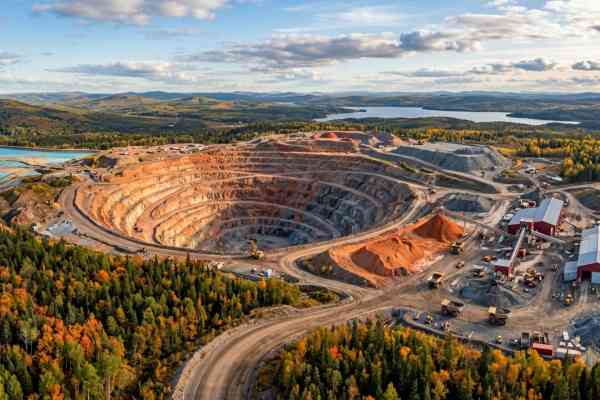
To meet the massive, global demand from these software-defined vehicle fleets and the associated data centres for emission-free base-load energy, the focus is shifting, particularly in the West, towards reliable sources of raw materials. Notably, the Canadian explorer Standard Uranium fits seamlessly into this global picture, as it is searching the renowned Athabasca Basin for the essential fuel required for the many new nuclear power stations that must meet the rapidly rising electricity demand driven by the digitalized mobility transition. The uranium market is increasingly evolving from a commodities market into a strategic issue of energy and supply security. The sector is being driven by the renaissance of nuclear energy, which now faces years of underinvestment in new mining capacity.
A recent study by the US Geological Survey, as well as analyses by the IEA, highlight the high concentration of the global uranium supply and the growing need for investment across the entire nuclear supply chain. The IEA foresees new bottlenecks, particularly in uranium, conversion and enrichment. The latest exploration efforts in Canada's Athabasca Basin are therefore of great strategic importance. Alongside many other recently established companies, Standard Uranium has taken a significant step forward with the latest results from the Corvo project. The first drilling campaign in more than four decades confirmed anomalously high uranium grades in all 9 completed boreholes, thereby providing, for the first time, a coherent geological fingerprint of a uranium-bearing system. In total, 55 m with more than 10 ppm uranium were identified, including 23 m with over 50 ppm and 13 m with more than 100 ppm uranium. The geochemical signatures are of particular interest for further target identification, as the local values, ranging from 12 to 21, indicate a strong hydrothermal uranium influence. The lead isotope data appear almost spectacular: out of 405 samples analyzed, the average 206Pb/204Pb ratio was 147, whilst individual values rose as high as 5,100, thus providing an exceptionally clear radiogenic uranium signature. Additional fuel is being added by the Manhattan Zone, where historical surface samples returned grades of up to 8.10% U₃O₈. However, such historical or selective surface-sampling results should, of course, not yet be equated with a defined mineral resource.
IIF presenter Lyndsay Malchuk in conversation with CEO Jon Bey about the progress of the drilling program in the Athabasca Basin.
The drilling also continued to confirm graphitic structures, highly deformed zones, and hydrothermal alteration across multiple target areas. This is an encouraging sign that supports further exploration. To date, Standard Uranium has not yet defined a commercial deposit, but it has passed a crucial exploration test: the system is not confined to a single point, but is evident across multiple target areas along kilometre-long structures. Corvo boasts more than 29 km of structural corridors and numerous targets that have yet to be tested. Standard Uranium's trump card is its project-generator model, with the winter campaign financed by its partner Aventis, whilst Standard Uranium, as the operator, contributes its technical expertise and exploration experience. With additional geophysical and near-surface work, as well as a second drilling phase in 2027, the aim is now to turn the geochemical fingerprint into a precisely defined discovery target. Should Standard Uranium succeed in actually delineating high-grade uranium mineralization within these kilometre-long structural corridors, Corvo could evolve from an early-stage greenfield project into one of the most interesting new uranium discovery stories in the Athabasca Basin. Plenty of potential for a market capitalization of just CAD 12 million!
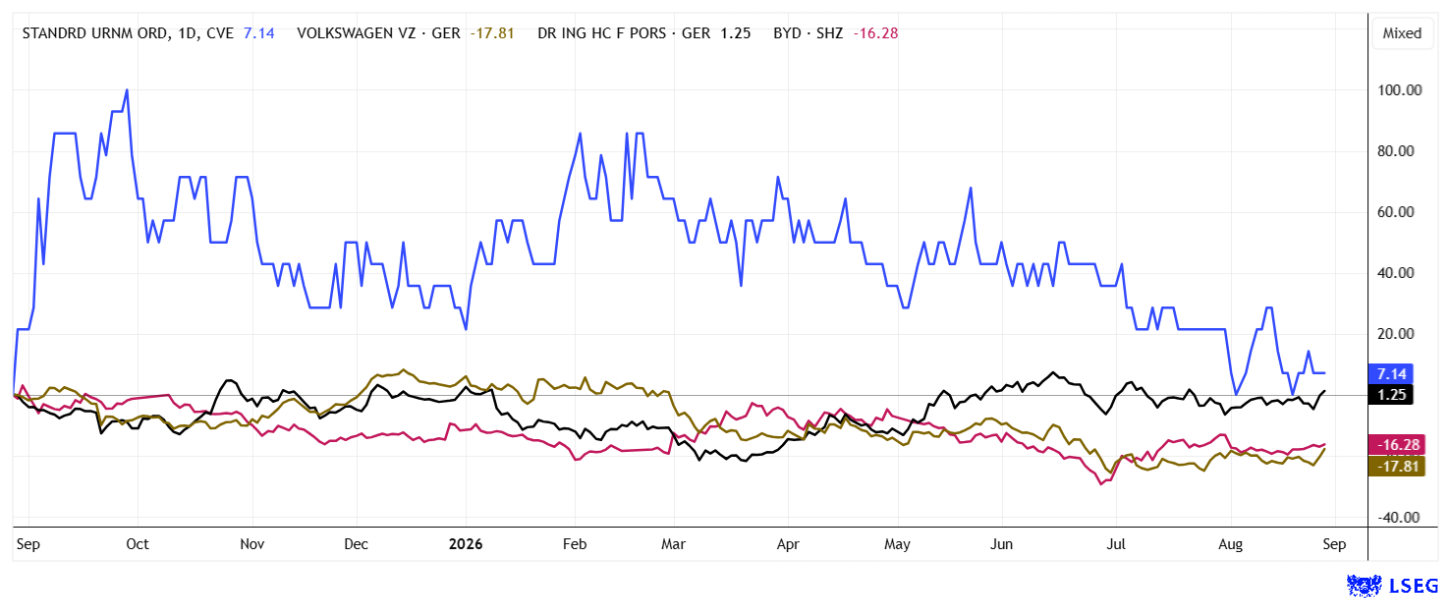
The stock market is torn between geopolitical despair and an existing urge to turn the major advances of the new AI high-tech generation into hard cash. While many areas of the Nasdaq now reflect significant valuation premiums, the automotive sector is at a historic low. Investors are increasingly focusing on sector enablers such as Standard Uranium—the suppliers of the building blocks needed for the new AI energy infrastructure.
Conflict of interest
Pursuant to §85 of the German Securities Trading Act (WpHG), we point out that Apaton Finance GmbH as well as partners, authors or employees of Apaton Finance GmbH (hereinafter referred to as "Relevant Persons") currently hold or hold shares or other financial instruments of the aforementioned companies and speculate on their price developments. In this respect, they intend to sell or acquire shares or other financial instruments of the companies (hereinafter each referred to as a "Transaction"). Transactions may thereby influence the respective price of the shares or other financial instruments of the Company.
In this respect, there is a concrete conflict of interest in the reporting on the companies.
In addition, Apaton Finance GmbH is active in the context of the preparation and publication of the reporting in paid contractual relationships.
For this reason, there is also a concrete conflict of interest.
The above information on existing conflicts of interest applies to all types and forms of publication used by Apaton Finance GmbH for publications on companies.
Risk notice
Apaton Finance GmbH offers editors, agencies and companies the opportunity to publish commentaries, interviews, summaries, news and the like on news.financial. These contents are exclusively for the information of the readers and do not represent any call to action or recommendations, neither explicitly nor implicitly they are to be understood as an assurance of possible price developments. The contents do not replace individual expert investment advice and do not constitute an offer to sell the discussed share(s) or other financial instruments, nor an invitation to buy or sell such.
The content is expressly not a financial analysis, but a journalistic or advertising text. Readers or users who make investment decisions or carry out transactions on the basis of the information provided here do so entirely at their own risk. No contractual relationship is established between Apaton Finance GmbH and its readers or the users of its offers, as our information only refers to the company and not to the investment decision of the reader or user.
The acquisition of financial instruments involves high risks, which can lead to the total loss of the invested capital. The information published by Apaton Finance GmbH and its authors is based on careful research. Nevertheless, no liability is assumed for financial losses or a content-related guarantee for the topicality, correctness, appropriateness and completeness of the content provided here. Please also note our Terms of use.