July 16th, 2026 | 07:25 CEST
AI, Tech, Debt, and Ratings: Oracle Faces a Reality Check, Renk Searches for a Bottom, and Volatus Aerospace May Be Poised for a Technical Breakout
Oracle is pouring billions into the AI frenzy, thereby risking its credit rating. The result: investors are fleeing in droves, and the share price is plummeting. At the same time, Renk's share price has now collapsed by over 50% from its high. The German defence industry's rising star, along with Rheinmetall and Hensoldt, is desperately seeking a foothold. "Collective punishment" is the buzzword here! While the big names dominate the headlines, the Canadian aerospace company Volatus Aerospace may have finally done its technical analysis homework after turbulent times, with an open price gap now closed. Could this be a signal—or a starting gun? We analyze these three different companies and highlight where investors can still find interesting opportunities.
time to read: 4 minutes | Author: Matthias Schomber
ISIN: VOLATUS AEROSPACE INC | CA92865M1023 | TSXV: FLT , OTCQB: TAKOF , ORACLE CORP. DL-_01 | US68389X1054 , RENK AG O.N. | DE000RENK730
Table of contents:
Author

Matthias Schomber
Raised in Giessen, Hesse, Matthias Schomber discovered his passion for the financial markets as early as the 1990s—at a time when stock trading was still largely the domain of true, die-hard traders. After completing his banking apprenticeship, he worked for a private bank there and witnessed the rise and fall of the Neuer Markt firsthand on the trading floor of the Frankfurt Stock Exchange, drawing lessons from the experience that continue to shape his thinking as a trader, author, and trading system developer to this day.
Tag cloud
Shares cloud
Oracle: High-Risk AI Bet Brings Rating Agencies into the Picture
A look at the American database giant Oracle currently reveals a picture likely to make even die-hard, highly experienced tech investors break out in a sweat. The company has committed itself wholeheartedly to a massive expansion of its artificial intelligence infrastructure, but this strategy is proving to be a colossal financial feat.
The renowned rating agency S&P recently "pulled the ripcord" and downgraded Oracle's credit rating to BBB-, which is just one tiny notch above the dreaded junk status. The reason for this drastic measure lies in a dangerous combination of skyrocketing debt and enormous concentration risk.
Net debt has climbed to a dizzying USD 97.6 billion, while total debt stands at a staggering USD 130 billion. At the same time, the company is burning through massive amounts of cash, as reflected in a negative free cash flow of USD 23.7 billion in the just-concluded fiscal year 2026. The planned investments in new AI data centers for 2027 are expected to gobble up a staggering USD 90 to USD 95 billion.
To make matters worse, roughly half of the massive USD 638 billion order backlog depends on a single customer: OpenAI.
Should this flagship customer ever run into serious financial difficulties, Oracle faces the threat of a financial disaster. The stock market has already reacted unequivocally to these troubling prospects, causing the stock to plummet by more than 30% in a short period to around USD 129.
Renk: Brutal Correction - When Will the Bottom Be Reached?
However, anyone who believes that "more down-to-earth and traditional industries", which include a transmission manufacturer for the defence sector, currently offer a safe haven will be proven wrong by looking at Renk. The specialist in tank transmissions and marine propulsion technology has suffered an "extremely hard landing" on the stock market in recent months.
Following a spectacular surge, driven largely by general speculation surrounding European rearmament programs, investors have now been brought back to reality. Renk's share price is currently trading more than 50% below its striking October high of EUR 90.20. This massive crash makes it abundantly clear that the market had, in the meantime, priced in far too much, assuming the company could not deliver at this pace given the current situation.
The general sector rotation has led major investors to rigorously take their profits. While Renk's fundamental business remains intact and promising in the long term, investor confidence has been noticeably shaken for the time being. The stock is now struggling to find a solid foundation for a potential recovery within the range just above this year's lows, currently at EUR 43. If it fails to hold the EUR 40 mark, however, it could fall further toward EUR 30. It may not find a bottom until then.
Volatus Aerospace: Interesting Chart Pattern
The situation at Volatus Aerospace is currently somewhat different and a little more encouraging, as the company is attempting to master the transition to modern, autonomous aviation. The Canadian company, which specializes in commercial drone services and defence systems, has been working intensively behind the scenes in recent weeks. With a strong gross margin of 32% and cash and cash equivalents totaling CAD 41 million, the company is well-equipped for upcoming challenges and is in a fairly stable financial position.
Recent news has provided a few interesting details:
On June 23, Volatus announced the launch of its new 53,000-square-foot production and integration facility at Montreal-Mirabel Airport to meet the growing demand for autonomous systems in Canada and across the NATO region.
Shortly thereafter, on July 8, a regulatory development followed. The company's in-house drone system "Canary" became the first—and only—system ever to receive official approval from Transport Canada for commercial beyond-visual-line-of-sight (BVLOS) flights in populated areas, as it can detect hazards autonomously on board without external aids.
These announcements were rounded out on July 9 by the company's announcement of its participation in the MASS 2026 security conference, where Volatus will showcase its multi-directional capabilities for protecting Canada's Arctic sovereignty as well as its secure drone defence software, SKYDRA.
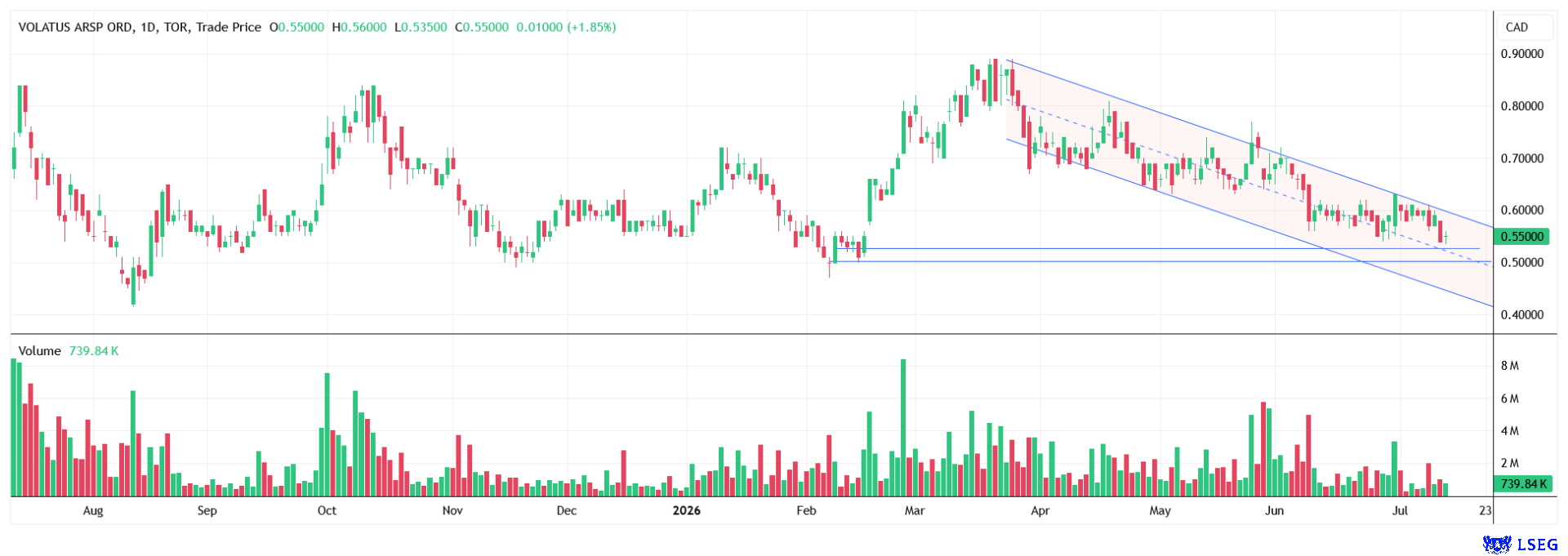
All of these fundamental developments are now also reflected in the chart. The share price has recently pulled back slightly, closing the gap from mid-February 2026 at CAD 0.55. This gap has now been neatly resolved on the chart. From a purely technical perspective, the price could now resume its upward trend. For this to happen, the stock would need to break out of its trend channel to the upside. This would have occurred if the price had risen above CAD 0.61 to 0.62. In any case, the conditions for this next step could be in place thanks to the current sales pipeline.
Ultimately, a potentially clearer picture is emerging for the coming months. Oracle faces the enormous challenge of quickly getting its massive debt under control and proving that its risky bet on artificial intelligence will truly deliver the promised returns before the rating agencies finally downgrade it to junk status.
Renk, on the other hand, must first rebuild confidence in the capital markets following the stock's 50% drop and demonstrate that its core business can live up to the initial hype in the long term.
Volatus Aerospace offers an interesting alternative in this challenging landscape. If the stock successfully breaks above the CAD 0.62 mark, the Canadian company's shares could potentially continue their upward trend.
Conflict of interest
Pursuant to §85 of the German Securities Trading Act (WpHG), we point out that Apaton Finance GmbH as well as partners, authors or employees of Apaton Finance GmbH (hereinafter referred to as "Relevant Persons") may hold shares or other financial instruments of the aforementioned companies in the future or may bet on rising or falling prices and thus a conflict of interest may arise in the future. The Relevant Persons reserve the right to buy or sell shares or other financial instruments of the Company at any time (hereinafter each a "Transaction"). Transactions may, under certain circumstances, influence the respective price of the shares or other financial instruments of the Company.
In addition, Apaton Finance GmbH is active in the context of the preparation and publication of the reporting in paid contractual relationships.
For this reason, there is a concrete conflict of interest.
The above information on existing conflicts of interest applies to all types and forms of publication used by Apaton Finance GmbH for publications on companies.
Risk notice
Apaton Finance GmbH offers editors, agencies and companies the opportunity to publish commentaries, interviews, summaries, news and the like on news.financial. These contents are exclusively for the information of the readers and do not represent any call to action or recommendations, neither explicitly nor implicitly they are to be understood as an assurance of possible price developments. The contents do not replace individual expert investment advice and do not constitute an offer to sell the discussed share(s) or other financial instruments, nor an invitation to buy or sell such.
The content is expressly not a financial analysis, but a journalistic or advertising text. Readers or users who make investment decisions or carry out transactions on the basis of the information provided here do so entirely at their own risk. No contractual relationship is established between Apaton Finance GmbH and its readers or the users of its offers, as our information only refers to the company and not to the investment decision of the reader or user.
The acquisition of financial instruments involves high risks, which can lead to the total loss of the invested capital. The information published by Apaton Finance GmbH and its authors is based on careful research. Nevertheless, no liability is assumed for financial losses or a content-related guarantee for the topicality, correctness, appropriateness and completeness of the content provided here. Please also note our Terms of use.