November 5th, 2026 | 05:28 CET
AI rally starts to sputter! Dramatic catch-up rally at SAP and Aspermont, but ServiceNow and Oracle in free fall
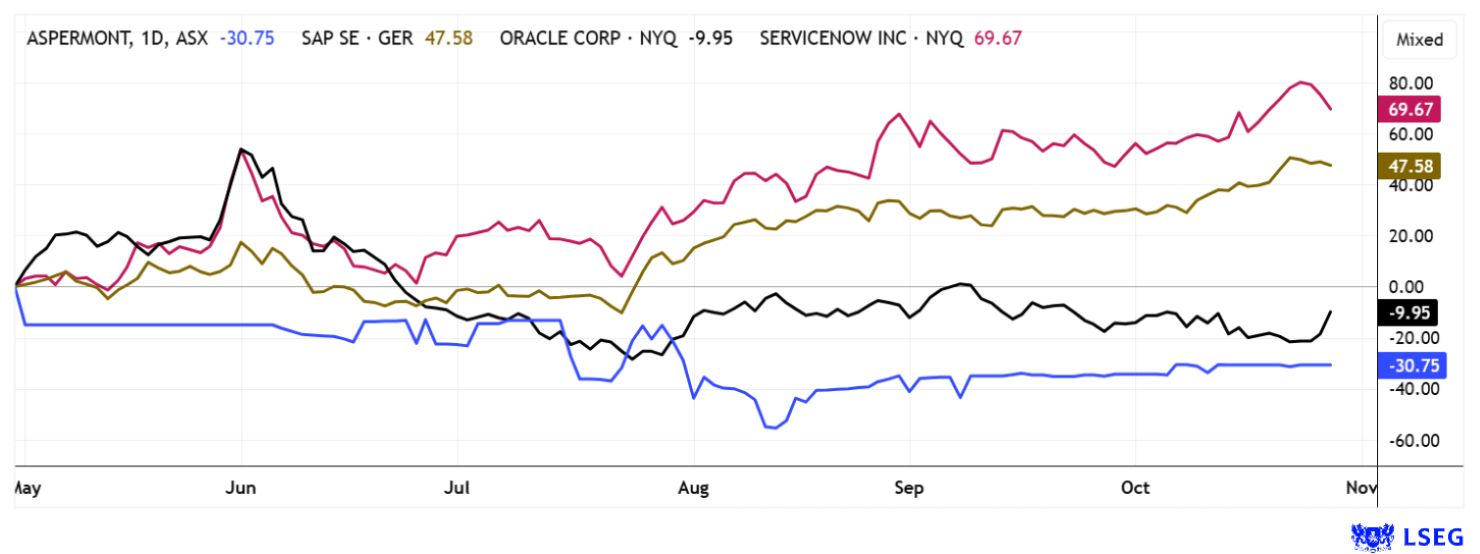
The AI hype of recent months is slowing as expected and is noticeably throwing the entire software industry off course! After a seemingly unstoppable ascent, disillusionment is spreading on Wall Street, as the tech giants' extremely high valuations are becoming increasingly difficult to justify through actual revenue surges. This sudden scepticism about growth is dragging heavyweights such as ServiceNow and Oracle deep into the red, as investors take profits and confidence in near-term AI monetisation fades. Yet while the US pioneers are in free fall, a highly exciting catch-up race is unfolding elsewhere. European software giant SAP shines as a rock in the surf in this turbulent environment, as its cloud solutions, deeply integrated into everyday business operations, reliably generate record revenues. At the same time, small-cap specialist Aspermont is delivering a genuine surprise and attracting new investor interest with a rapid operational transformation. This market split clearly shows that investors must distinguish between vague promises and profitable substance. The software sector is undergoing a complete realignment; we sharpen our pencils and check the numbers.
time to read: 5 minutes | Author: André Will-Laudien
ISIN: Aspermont Ltd | AU000000ASP3 , SAP SE | DE0007164600 , US81762P1021 , ORACLE CORP. | US68389X1054
Table of contents:
Author

André Will-Laudien
Born in Munich, he first studied economics and graduated in business administration at the Ludwig-Maximilians-University in 1995. As he was involved with the stock market at a very early stage, he now has more than 30 years of experience in the capital markets.
Tag cloud
Shares cloud
SAP - A 70% increase in 3 months is a potential record
The stock market is trembling – but not in every sector! European software giant SAP is staging a breathtaking rally despite the harsh climate, leaving its struggling US competitors behind with a spectacular share price jump of almost 70% since its low for the year! The fundamental driver of this share price surge is a stellar set of figures, now also in Q3, in which the group broke through the historic threshold of EUR 10 billion in quarterly revenue for the first time. Driven by a booming cloud business, which rose 25% at constant currencies to EUR 6.67 billion, earnings per share also rose sharply to EUR 1.96. Buoyed by this operational success, management raised its annual forecast for cloud revenue and is targeting a robust operating profit of up to EUR 12.3 billion for full-year 2026. Meanwhile, the rumour mill behind the extremely high valuation is in overdrive, as investors speculate that SAP can integrate the monetisation of its artificial intelligence "Joule" into day-to-day business much faster and more profitably than expected. In addition, the success of the ongoing share buyback programme, worth billions, is fuelling the buying frenzy on the trading floor. Despite occasional share price corrections, including a dip to EUR 217, the DAX-listed group is currently regarded on the stock market as the ultimate "safe haven" in the technology sector. Analysts are raising their price targets, as the immense cloud order backlog of EUR 24.1 billion guarantees reliable revenue for the coming years. 24 of 34 experts on the LSEG platform agree on an average 12-month price target of EUR 236, a good 12% above recent strong price levels.
ServiceNow and Oracle – Pressure on the software sector is increasing again
Across the pond, SAP's sector rival ServiceNow is coming under heavy fire despite solid revenue growth. The reason: a cautious outlook has dampened investors' ambitious AI dreams. Although Q3 revenue climbed by over 20% to USD 4.11 billion, adjusted earnings per share of USD 1.00 fell just short of expectations. The real drama, however, unfolded in future contracted revenue, whose projected growth for the final quarter fell noticeably to 18.5%. This setback immediately fuelled fears on Wall Street of a significant margin contraction in the core segment. The shares promptly responded with a brutal plunge of almost 27% to just under USD 100. In the preceding weeks, the stock had still climbed from USD 90 to over USD 160 - what volatility! Investors are now painfully realising that the hype surrounding the new AI agents, worth billions, is translating into actual net profits much more slowly than previously priced in. A full 43 of the 48 analysts on the LSEG platform remain positive, however, with the blended price target averaging USD 159, around 50% higher than the price on the board yesterday.
Investors are also becoming increasingly concerned about database veteran Oracle. The latest figures showed a noticeable slowdown in growth in the key cloud revenue stream, which eased from 55% previously to 50% now. This slowdown was enough for the stock market to bring back deep-seated fears of weakening demand in the overheated AI market. Although the group beat estimates with adjusted earnings of USD 1.92 per share, scepticism prevailed. Once again, it is the whisper estimates that a highly valued tech stock must also beat. At Oracle, debt levels deemed too high are an additional burden. The shares nosedived, surrendering much of their gains from previous weeks. Even the gigantic revenue targets for 2030 announced at the same time could not entirely dispel investors' acute doubts. Analysts, however, remain surprisingly calm, with a calculated 12-month share price upside of over 85% to USD 238. Exciting!
Aspermont – AI transformation ushers in a new era
In the modern tech industry, data is the most important raw material. Around 50 years ago, the trend towards "data processing" began, evolving into today's information technology and now driving all high-tech segments through complex data models. One gigantic collector of this valuable information from the commodities world is Australia's Aspermont Limited. The company has long since transformed itself from a traditional media group into a globally leading B2B platform for decision intelligence, digitally monetising its more than 190 years of industry expertise. Over 4,000 corporate customers in 150 countries, including more than a quarter of the Fortune 100 giants, rely on this scalable platform approach. At its heart is recurring subscription revenue, which has now grown for the 40th consecutive quarter and, as a stable source of cash flow, finances the development of new, highly profitable AI products.
A look at the latest operational successes reveals record momentum. Revenue from continuing operations rose 1% to AUD 15.2 million in the 2026 financial year, while revenue from subscriptions and data licences remained unchanged at AUD 10.2 million. Non-subscription revenue rose 4% to AUD 5.0 million, led by Nexus (+127%) and growth in digital advertising and events (+9%), offsetting the ongoing structural decline in print advertising. The closely watched annual recurring revenue (ARR) rose 4% to AUD 11.6 million as at September 30, marking a 10-year record in subscription growth from June 2016 through June 2026. The normalised EBITDA of minus AUD 1.3 million for the 2026 financial year reflects planned investments to build up the Data & Intelligence division. The global data pipeline is in place, initial customer revenues are already coming in, and management is targeting even deeper market penetration through rising average revenue per user (ARPU). The planned expansion of lucrative enterprise contracts with major customers and the rollout of further data-based analytical tools in the coming months provide additional upside potential. The stage is thus set for continued scaling of the high-margin platform model.
IIF presenter Lyndsay Malchuk interviewed company founder and CEO Alex Kent about the future prospects.
The outlook promises a noticeable scaling-up of operating profitability. According to GBC Research, operating earnings (EBITDA) are expected to rise to around AUD 2.93 million by 2028, while revenues are likely to climb to over AUD 21 million. Given these prospects, the current stock market valuation of AUD 15 million appears extremely low, which is why GBC has reiterated its Buy recommendation. Cash stood at a substantial AUD 1.6 million as at September 30, 2026. GBC set its price target at AUD 5.45 (EUR 3.30), representing exceptional upside potential of almost 400% from the current share price of AUD 1.25. Investors should assess the current situation for medium-term entry opportunities!
Conclusion
International equity markets continue to oscillate between corporate results and geopolitical disruptions. Rising oil prices are driving up inflation and interest rates, entrenching persistent market unrest. Investors looking to rebalance or diversify more broadly will once again find genuine entry opportunities in the long-punished software sector: sentiment is gradually turning positive, and fundamental P/E ratios are at a 5-year low.
Conflict of interest
Pursuant to §85 of the German Securities Trading Act (WpHG), we point out that Apaton Finance GmbH as well as partners, authors or employees of Apaton Finance GmbH (hereinafter referred to as "Relevant Persons") currently hold or hold shares or other financial instruments of the aforementioned companies and speculate on their price developments. In this respect, they intend to sell or acquire shares or other financial instruments of the companies (hereinafter each referred to as a "Transaction"). Transactions may thereby influence the respective price of the shares or other financial instruments of the Company.
In this respect, there is a concrete conflict of interest in the reporting on the companies.
In addition, Apaton Finance GmbH is active in the context of the preparation and publication of the reporting in paid contractual relationships.
For this reason, there is also a concrete conflict of interest.
The above information on existing conflicts of interest applies to all types and forms of publication used by Apaton Finance GmbH for publications on companies.
Risk notice
Apaton Finance GmbH offers editors, agencies and companies the opportunity to publish commentaries, interviews, summaries, news and the like on news.financial. These contents are exclusively for the information of the readers and do not represent any call to action or recommendations, neither explicitly nor implicitly they are to be understood as an assurance of possible price developments. The contents do not replace individual expert investment advice and do not constitute an offer to sell the discussed share(s) or other financial instruments, nor an invitation to buy or sell such.
The content is expressly not a financial analysis, but a journalistic or advertising text. Readers or users who make investment decisions or carry out transactions on the basis of the information provided here do so entirely at their own risk. No contractual relationship is established between Apaton Finance GmbH and its readers or the users of its offers, as our information only refers to the company and not to the investment decision of the reader or user.
The acquisition of financial instruments involves high risks, which can lead to the total loss of the invested capital. The information published by Apaton Finance GmbH and its authors is based on careful research. Nevertheless, no liability is assumed for financial losses or a content-related guarantee for the topicality, correctness, appropriateness and completeness of the content provided here. Please also note our Terms of use.