June 29th, 2026 | 07:30 CEST
AI and M&A Frenzy in the Life Sciences Sector: Bayer, Vidac Pharma, Novo Nordisk, Evotec, and Eli Lilly
Yes, you read that correctly. Pharmaceutical companies are actively embracing artificial intelligence (AI) and, thanks to lower costs, better validation, and faster study setups, could emerge as winners of the new AI wave in the medium term. Many stocks in the life sciences sector had been overlooked by the market, but investors are now taking notice again. Eli Lilly is betting on AI and expanding its portfolio through targeted acquisitions, including the takeovers of sleep-wake specialist Centessa Pharmaceuticals and blood cancer specialist Ajax. At Evotec and Vidac Pharma, much of the focus is on cancer, while Novo Nordisk faces stiff competition from Eli Lilly's weight-loss drugs. Then came the welcome news regarding Bayer. The Supreme Court ruled that approximately 181,000 individual lawsuits alleging a lack of warning labels on packaging are no longer legally viable, as the US Environmental Protection Agency (EPA) has classified the herbicide glyphosate as safe. Lots of good news, and plenty of opportunities for active investors - we provide a few insights.
time to read: 5 minutes | Author: André Will-Laudien
ISIN: VIDAC PHARMA HOLDING PLC | GB00BM9XQ619 , NOVO NORDISK A/S | DK0062498333 , EVOTEC SE INH O.N. | DE0005664809 , ELI LILLY | US5324571083 , BAYER AG NA O.N. | DE000BAY0017
Table of contents:
Author

André Will-Laudien
Born in Munich, he first studied economics and graduated in business administration at the Ludwig-Maximilians-University in 1995. As he was involved with the stock market at a very early stage, he now has more than 30 years of experience in the capital markets.
Tag cloud
Shares cloud
Novo Nordisk and Eli Lilly: Obesity in the Margin War
Eli Lilly and Novo Nordisk are locked in a fierce battle for market share in the multi-billion-dollar market for obesity and diabetes medications. As competition escalates due to new active ingredients and the addition of oral formulations, both companies are increasingly responding with aggressive pricing strategies to secure hard-won market share. Novo Nordisk has announced price cuts, some of them drastic, for its drugs Wegovy and Ozempic. The goal is to persuade US insurers and employers to cover the costs more broadly and to regain US market leadership after Eli Lilly temporarily achieved over 60% market share there through aggressive marketing and pricing. Eli Lilly is pushing its new oral medication "Foundayo" to market via telemedicine platforms at competitive prices—such as USD 149 for out-of-pocket patients—further increasing pressure on the Danish company's oral portfolio. The margin war is also being fought over efficacy. Eli Lilly has achieved impressive results in studies with new pipeline compounds such as orforglipron and retatrutide. This increases the pressure on Novo Nordisk to keep pace in the clinical race. While Eli Lilly's stock has gained over 50% since the summer of 2025, the Danish company is still grappling with losses of just under 24%. Both stocks are extremely exciting and not too expensive!
Vidac Pharma: Clinical Milestones with an Innovative Metabolic Approach and a Strong Patent Portfolio
It is always worth taking a closer look at Vidac Pharma. With its distinctive scientific approach, the innovative biotech company deliberately moves away from conventional oncology pathways and focuses on the biological origin of many cancers: dysregulated cellular metabolism. Vidac Pharma is developing novel first-in-class therapies for cancer and onco-dermatological diseases, pursuing an approach that intentionally differs from traditional treatment strategies. The central focus of the research is not on the direct destruction of tumour cells, but rather on the targeted correction of their disrupted energy metabolism via the metabolic switch Hexokinase-2. This is intended to strip cancer cells of their survival advantages and trigger a return to programmed cell death.
With this strategy, the company addresses the Warburg effect, which has been the subject of intensive research for years, and positions itself in a scientific field that is gaining increasing importance in light of growing resistance to established therapies. In May, Vidac initially focused on expanding its strategic presence in Europe and held advanced discussions about joining the renowned life sciences accelerator Quest for Health in the tri-border region of France, Germany, and Switzerland. The network brings together leading biotechnology companies, research institutions, clinics, and investors, and has mobilized more than EUR 220 million in financing for its member companies over the past three years. Attractive prospects for collaborations and future commercialization lie ahead for Vidac.
In addition, the company is exploring the establishment of an operational unit in Strasbourg and is seeking an experienced executive to drive its expansion into one of Europe's most significant biotechnology clusters. A few weeks later, the next strategic milestone followed when Canada granted approval for another patent on the company's proprietary piperazine derivatives, further expanding its international intellectual property portfolio. Together with existing intellectual property rights, including key patents valid through 2045, this significantly strengthens the company's negotiating position with potential licensing and pharmaceutical partners.
On the operational front, the focus has recently shifted to the clinical development of the lead compound VDA-1102, whose mechanism of action specifically targets the altered metabolism of cancer cells while sparing healthy tissue as much as possible. In mid-June, Vidac announced the on-schedule completion of patient recruitment for the randomized Phase 2b trial in high-risk actinic keratosis, with all 39 planned participants enrolled within the announced timeline. Investors are paying particularly close attention to the ongoing follow-up period, during which no significant side effects have been reported so far, although reliable conclusions regarding efficacy will only be possible after the statistical analysis is complete. Initial topline data are expected upon completion of the three-month follow-up period and could become the next key driver of the share price.
Evotec: Activist Investors Demand Strategic Changes
Pressure is noticeably mounting at the Hamburg-based drug developer Evotec. Trading at around EUR 4.80, the stock is just under 20% away from its 52-week low of EUR 4.02; the stock had reached EUR 7.75 in 2026. At the center of the discussions is the US subsidiary Just Evotec Biologics. Activist investor MAK Capital is pushing for a spin-off or listing of this valuable division, as its true value is hardly reflected in Evotec's stock price. At the same time, Evotec is exploring further strategic options for its entire portfolio. The investment banks Morgan Stanley and Moelis & Company are advising on the process. At the annual shareholders' meeting on June 11, management did not yet announce a decision regarding the spin-off. However, market expectations have risen noticeably amid the many rumours. The fact that board members such as Dr. Cord Dohrmann must occasionally sell shares from their stock option programs is not a negative sign, but rather often a tax-related necessity. Evotec is on the close watchlist due to numerous behind-the-scenes developments; purchases have the potential to double in value over a 12- to 24-month horizon. Risk-aware investors are accumulating shares in the EUR 4.50-5.00 range!
Bayer: Good News from the US
This could be Bayer's breakthrough. The Leverkusen-based company can breathe a sigh of relief for now, as the pharmaceutical and agricultural conglomerate has achieved a landmark victory before the US Supreme Court in the multi-billion-dollar US legal dispute over alleged cancer risks associated with the weed killer Roundup and the controversial active ingredient glyphosate. The justices ruled by a 7-2 majority that federal law takes precedence over the laws and warning requirements of individual states. As a result, Bayer no longer has to fear being held liable or sued in individual US states for failing to include warning labels. The US Environmental Protection Agency (EPA) classifies glyphosate as safe and has not required corresponding cancer warnings on product packaging. The federal agency's decisions override conflicting requirements at the state level. According to the ruling, the legal basis for the majority of the approximately 181,000 pending Roundup lawsuits has been eliminated. A day to celebrate—Bayer's share price skyrocketed from EUR 39 to just under EUR 47 within an hour. From a technical perspective, a handle-and-cup formation could now emerge, which would clear the way to the EUR 57–65 range. A true blessing for the beleaguered shareholders!
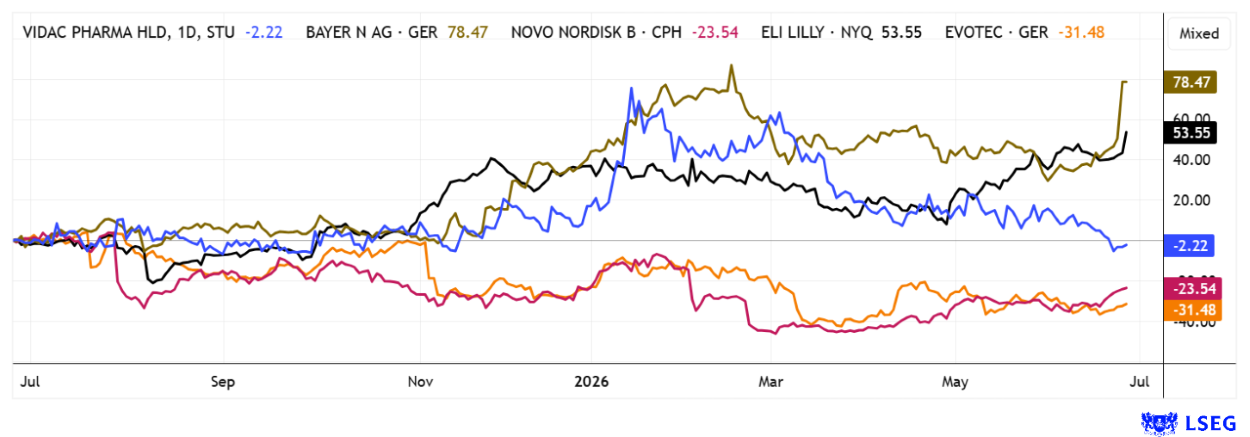
Sector rotation is key! The life sciences sector has long been neglected, but is now experiencing a resurgence. Leading the way is the landmark US Supreme Court ruling in favour of Bayer. Investors are also closely watching Eli Lilly for its elevated acquisition activity and the restructuring efforts at Novo Nordisk. This leaves Vidac Pharma and Evotec, which could already be on the radar as potential acquisition targets for financial investors or industry giants.
Conflict of interest
Pursuant to §85 of the German Securities Trading Act (WpHG), we point out that Apaton Finance GmbH as well as partners, authors or employees of Apaton Finance GmbH (hereinafter referred to as "Relevant Persons") currently hold or hold shares or other financial instruments of the aforementioned companies and speculate on their price developments. In this respect, they intend to sell or acquire shares or other financial instruments of the companies (hereinafter each referred to as a "Transaction"). Transactions may thereby influence the respective price of the shares or other financial instruments of the Company.
In this respect, there is a concrete conflict of interest in the reporting on the companies.
In addition, Apaton Finance GmbH is active in the context of the preparation and publication of the reporting in paid contractual relationships.
For this reason, there is also a concrete conflict of interest.
The above information on existing conflicts of interest applies to all types and forms of publication used by Apaton Finance GmbH for publications on companies.
Risk notice
Apaton Finance GmbH offers editors, agencies and companies the opportunity to publish commentaries, interviews, summaries, news and the like on news.financial. These contents are exclusively for the information of the readers and do not represent any call to action or recommendations, neither explicitly nor implicitly they are to be understood as an assurance of possible price developments. The contents do not replace individual expert investment advice and do not constitute an offer to sell the discussed share(s) or other financial instruments, nor an invitation to buy or sell such.
The content is expressly not a financial analysis, but a journalistic or advertising text. Readers or users who make investment decisions or carry out transactions on the basis of the information provided here do so entirely at their own risk. No contractual relationship is established between Apaton Finance GmbH and its readers or the users of its offers, as our information only refers to the company and not to the investment decision of the reader or user.
The acquisition of financial instruments involves high risks, which can lead to the total loss of the invested capital. The information published by Apaton Finance GmbH and its authors is based on careful research. Nevertheless, no liability is assumed for financial losses or a content-related guarantee for the topicality, correctness, appropriateness and completeness of the content provided here. Please also note our Terms of use.