July 23rd, 2026 | 11:55 CEST
The New China: Power Metallic Mines, GE Aerospace, and DHL Group See Investment Opportunities in Saudi Arabia
The FIFA World Cup has just come to an end, and the roadmap for future tournaments is already in place. The most forward-looking executives are now turning their attention to the host nation of the 2034 FIFA World Cup: Saudi Arabia. The Kingdom is not only awash in cash—it is also opening up more and more and strategically channeling its vast oil wealth into new industries. Three companies that stand to benefit particularly from this transformation are Canadian resource explorer Power Metallic Mines, the US jet engine manufacturer GE Aerospace, and the logistics giant DHL Group, still affectionately known to many investors as the former Deutsche Post. At the same time, all three companies are positioned at the center of major long-term trends, including rising military spending, secure supply chains, electric mobility, and the continued growth of e-commerce.
time to read: 6 minutes | Author: Jens Castner
ISIN: POWER METALLIC MINES INC. | CA73929R1055 | TSXV: PNPN , OTCBB: PNPNF , General Electric Company | US3696043013 , DEUTSCHE POST AG NA O.N. | DE0005552004
Table of contents:
Author

Jens Castner
The Nuremberg native brings over three decades of capital markets experience, backed by a career shaped by deep market insight and a genuine passion for investing. His journey began in 1994 through an investment club among colleagues – a formative experience that sparked a lifelong dedication to identifying compelling investment opportunities.
Following senior editorial roles at Nürnberger Nachrichten, €uro am Sonntag, and €uro, he went on to serve as Editor-in-Chief of the renowned investor magazine Börse Online from 2014, where he played a key role in shaping high-quality financial journalism for a broad investor audience.
Tag cloud
Shares cloud
Saudi Arabia: More Than Just Sand, Camels, and Oil
What is often still dismissed as a desert nation with a few oil wells is rapidly evolving into the West's economic hub, just as China did in earlier decades. As the host country of the 2034 World Cup, Saudi Arabia aims not only to take the global stage in sports but also in the economy. And it is already doing so in the run-up to the event. Under the umbrella of "Vision 2030," enormous amounts of capital are flowing into tourism, technology, renewable energy, and mining—to wean the economy off its dependence on oil. The sovereign wealth fund PIF manages approximately USD 913 billion and ranks among the five largest of its kind worldwide. Oil and money are abundant, but unlike other petro-states, Riyadh is investing in foreign partnerships rather than consumption. Three companies from different industries demonstrate just how broadly this opening is already taking hold. All three maintain joint ventures in the Kingdom—that is, joint subsidiaries with local partners.
Power Metallic Mines: The Raw Materials Supplier of the Future
This move is most striking in the case of Power Metallic Mines, a Toronto-based explorer. Through its subsidiary Power Metallic Arabia, the Canadian company has secured the Jabal-Baudan license in the Jabal-Sayid Belt—a region considered highly prospective for copper, gold, and zinc and described by CEO Terry Lynch as "one of the most important new mining jurisdictions." Jabal-Sayid is also the name of a world-renowned copper mine operated by Barrick Mining as a joint venture with the Saudi mining company Ma'aden. Power Metallic Mines, on the other hand, is partnering with the local Amaar United Mining Company. Both partners intend to jointly participate in future license auctions in the Kingdom, with equal ownership and initial funding commitments of USD 2.5 million for Power Metallic and USD 7.5 million for Amaar. For the management team led by CEO Lynch, this partnership thus represents a capital-efficient way to expand the portfolio without neglecting the core business.
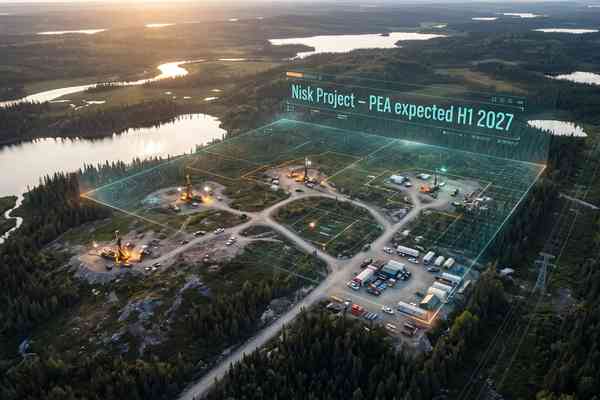
This core business remains the Nisk-Lion-Tiger Project in Québec, an area of approximately 330 km² containing a high-grade deposit of copper, nickel, and platinum group metals. Additionally, the ground there also contains gold and silver. Drilling to date has yielded grades significantly higher than those found in comparable copper projects worldwide. The combination of copper, nickel, and precious metals makes the deposit particularly attractive to two key industries. The defence industry requires these raw materials for heat-resistant superalloys in engines, while the electric vehicle sector consumes large quantities of copper for motors and high-voltage cables.
A mineral resource estimate for Lion and Nisk is scheduled to be presented at the end of July, followed by a preliminary economic assessment (PEA). The Augsburg-based research firm GBC Research considers a project value of over CAD 1 billion possible should the resource be confirmed as expected. Power Metallic Mines' market capitalization, at around CAD 238 million, is less than a quarter of that amount. Consequently, the company's activities in Saudi Arabia have so far been ignored by the market. The company is financially secured by a CAD 28.2 million funding round completed in June, in which commodities super-investor Eric Sprott alone subscribed for CAD 2.0 million. Mining veterans Robert Friedland and Rob McEwen are also among the shareholders, a fact that is regarded in the industry as a sign of confidence. Analysts conclude that the stock is worth CAD 3.00. It is currently trading at CAD 1.08 in Toronto and at EUR 0.65 on German exchanges.
GE Aerospace: Over 40 Years of Partnership with Riyadh
One of Power Metallic Mines' potential customers is GE Aerospace, a US engine specialist whose partnership with Saudi Arabia dates back more than 40 years. The company's joint ventures supply the four largest Saudi airlines and maintain the largest fleet of F110 fighter jet engines outside the United States. For example, in November 2025, Saudia ordered GEnx engines for its new Boeing 787 aircraft, along with a multi-year maintenance program; in February 2026, GE Aerospace signed expanded maintenance contracts with the Middle East Propulsion Company for the Royal Air Force.
GE Aerospace has its roots in the restructuring of the former conglomerate General Electric, which was split into three independent companies under CEO Larry Culp: GE HealthCare went public in 2023, followed by GE Vernova and GE Aerospace in April 2024. Since then, the Aerospace division has operated as an independent company and is considered the world's largest manufacturer of aircraft engines.
Amid the surge in defence stocks, GE Aerospace's stock reached a record high of over USD 380 on July 3 and, following a correction, is currently trading at around USD 340—still well above the level of a year ago. The reason for the steep rise in the share price since mid-May is solid financial performance. In the second quarter, GE Aerospace exceeded expectations with earnings per share of USD 2.02 and revenue of USD 12.63 billion. This marked the fifth consecutive quarter of growth exceeding 20%. The order backlog in the service business totals USD 170 billion, and management raised its full-year forecast. The overwhelming majority of Wall Street analysts recommend buying the stock, with price targets mostly hovering around USD 400. One caveat remains: with a price-to-earnings (P/E) ratio of around 40, the stock is ambitiously valued despite the minor correction.
DHL Group: Downsizing in Germany, Expansion in the Middle East
While GE Aerospace supplies engines, its potential customer, DHL Group, uses its own aircraft and trucks to ensure goods actually reach their destinations. This includes Saudi Arabia. As early as 2023, DHL Supply Chain partnered with the world's largest oil company, Aramco, to establish a joint venture for a procurement and logistics hub—the first of its kind for the industrial, energy, and chemical sectors in the Kingdom. At the signing ceremony, Aramco CEO Amin Nasser praised DHL's leadership role as evidence of their long-standing collaboration. In 2025, the company acquired a stake in the Saudi parcel logistics firm AJEX and made a EUR 130 million investment in a new warehouse in Riyadh's Special Logistics Zone.
After a long dry spell, DHL shares are once again on their way back to the 2021 highs of over EUR 60 and recently reached their highest level since January 2022. A key factor is the "Fit for Growth" cost-cutting program, which is expected to save approximately EUR 1 billion by 2027 and includes, among other measures, eliminating 8,000 jobs in the German mail and package business. Following strong quarterly results, the Executive Board raised its earnings forecast for 2026, from over EUR 6.2 billion to over EUR 6.5 billion in operating profit, and expanded the share buyback program to EUR 6.0 billion.
The former Deutsche Post is a reliable dividend payer, with a dividend of EUR 1.85 per share announced for 2026, and is now also attracting momentum investors due to its intact upward trend. However, since the P/E ratio has now risen to 16 along with the share price, major research firms view further upside potential as limited. Many analysts' price targets, currently at EUR 56.60, have already been exceeded, and the EUR 60 targets set by JPMorgan and Deutsche Bank are not far off. Only Barclays Capital still sees about 10% growth potential for DHL, with a price target of EUR 62. That does not necessarily mean anything, though. Experience shows that banks raise their price targets when reality outpaces their mathematical models.
Conclusion: Bright Future Outlook Thanks to Stable Trends
Saudi Arabia is opening up to foreign capital and expertise at a pace reminiscent of China in the early 2000s. Whether through an exploration license for a Canadian junior mining company, an engine partnership with a global American corporation, or as a logistics hub for a long-established German firm—the Kingdom is forging alliances across industries with a long-term perspective. With the 2034 FIFA World Cup, the country's economic opening is likely to reach its preliminary peak. Investors who want to join this journey today are also betting, through the three stocks described, on structural trends that extend far beyond business with the Saudis. As online retail continues to grow, DHL will deliver ever-larger volumes of packages in the future. Globally, defence spending is rising, and with it, the demand for engines and maintenance services from GE Aerospace. The raw materials for these will be supplied in the near future by companies such as Power Metallic Mines, which mine in politically stable regions, as Western governments want (and must!) end their dependence on imports from China and Russia.
Conflict of interest
Pursuant to §85 of the German Securities Trading Act (WpHG), we point out that Apaton Finance GmbH as well as partners, authors or employees of Apaton Finance GmbH (hereinafter referred to as "Relevant Persons") may hold shares or other financial instruments of the aforementioned companies in the future or may bet on rising or falling prices and thus a conflict of interest may arise in the future. The Relevant Persons reserve the right to buy or sell shares or other financial instruments of the Company at any time (hereinafter each a "Transaction"). Transactions may, under certain circumstances, influence the respective price of the shares or other financial instruments of the Company.
In addition, Apaton Finance GmbH is active in the context of the preparation and publication of the reporting in paid contractual relationships.
For this reason, there is a concrete conflict of interest.
The above information on existing conflicts of interest applies to all types and forms of publication used by Apaton Finance GmbH for publications on companies.
Risk notice
Apaton Finance GmbH offers editors, agencies and companies the opportunity to publish commentaries, interviews, summaries, news and the like on news.financial. These contents are exclusively for the information of the readers and do not represent any call to action or recommendations, neither explicitly nor implicitly they are to be understood as an assurance of possible price developments. The contents do not replace individual expert investment advice and do not constitute an offer to sell the discussed share(s) or other financial instruments, nor an invitation to buy or sell such.
The content is expressly not a financial analysis, but a journalistic or advertising text. Readers or users who make investment decisions or carry out transactions on the basis of the information provided here do so entirely at their own risk. No contractual relationship is established between Apaton Finance GmbH and its readers or the users of its offers, as our information only refers to the company and not to the investment decision of the reader or user.
The acquisition of financial instruments involves high risks, which can lead to the total loss of the invested capital. The information published by Apaton Finance GmbH and its authors is based on careful research. Nevertheless, no liability is assumed for financial losses or a content-related guarantee for the topicality, correctness, appropriateness and completeness of the content provided here. Please also note our Terms of use.