September 25th, 2026 | 07:20 CEST
Stocks for the Defense and Hydrogen Boom: Steyr Motors, Rheinmetall and dynaCERT
Some industries, and specific companies within them, require closer analysis. That is why today we are taking a closer look at two companies in the defense sector and one in the cleantech/hydrogen sector. Austrian engine manufacturer Steyr Motors is currently grappling with operational headwinds and technical challenges. The German defense conglomerate Rheinmetall is fundamentally on track to set new records, but it is currently hovering at a key price threshold and struggling to break through. The Canadian cleantech company dynaCERT continues to work toward a global breakthrough with its innovative emissions technology. Below, we dive into the balance sheets, margins and future prospects of these three stocks.
time to read: 5 minutes | Author: Matthias Schomber
ISIN: DYNACERT INC. | CA26780A1084 | TSX: DYA , OTCQB: DYFSF , RHEINMETALL AG | DE0007030009 , STEYR MOTORS AG | AT0000A3FW25
Table of contents:
Author

Matthias Schomber
Raised in Giessen, Hesse, Matthias Schomber discovered his passion for the financial markets as early as the 1990s—at a time when stock trading was still largely the domain of true, die-hard traders. After completing his banking apprenticeship, he worked for a private bank there and witnessed the rise and fall of the Neuer Markt firsthand on the trading floor of the Frankfurt Stock Exchange, drawing lessons from the experience that continue to shape his thinking as a trader, author, and trading system developer to this day.
Tag cloud
Shares cloud
Steyr Motors: Forecast Cut Puts the Brakes On
The Austrian specialist in high-performance engines is currently in a slump, at least according to its stock chart. Steyr was a company that, not long ago, was still being hailed by analysts for its innovative powertrain systems. Meanwhile, harsh economic realities have caught up with the company—and perhaps even overtaken it. The stock has lost significant ground since its highs and is now trading around EUR 30.80 in a rather volatile defense sector environment. It remains to be seen whether this rough patch can be overcome quickly or whether the headwinds will persist longer.
The business model focuses on extremely robust specialty propulsion systems for naval and military applications. However, revenue forecasts for 2026 had to be significantly revised downward to a range of just EUR 56 to 61 million. At the same time, the expected EBIT margin shrank to a modest 8% to 12%, significantly reducing profitability. These setbacks even forced management to put its ambitious medium-term targets for 2027 on hold for now. Operationally, the company must prove in the coming quarters that the postponed orders are not permanently lost to the competition or even lost entirely.
Despite the current headwinds, the company remains somewhat attractive to investors. The recently discussed dividend, which analysts have highlighted positively in the past, offers at least a small buffer for patient shareholders. Anyone investing now is betting on a classic turnaround and a recovery in the powertrain sector's order book in the coming months. However, until the operating metrics show a noticeable improvement and analysts set aside their skepticism, a healthy dose of caution is warranted with this small-cap stock. Only once the stock breaks above the EUR 35 mark is it likely to undergo a trend reversal. At that point, from a technical analysis perspective, it could once again present a "Buy" opportunity.
Rheinmetall: A Tough Battle for the Magical EUR 1,000 Mark
From Steyr, which is more of a niche player in the defense market, we turn to the heavyweight of the European defense industry. Rheinmetall's stock has been fluctuating for days around the psychologically crucial threshold of EUR 1,000. Surprisingly, even the opening of the Eudex defense trade show in Essen failed to provide any significant momentum, causing the share price to slip by over 2% to below EUR 1,000. The stock is thus a good 50% below its previous record high, which, according to technical analysts, suggests a potentially prolonged and stubborn consolidation phase. Nevertheless, the long-term fundamental environment remains strong due to ongoing and new geopolitical conflicts and massive waves of rearmament.
Operationally, the Düsseldorf-based group continues to run at full speed. In the second quarter, revenue jumped sharply from EUR 2.43 billion to EUR 3.29 billion, while earnings per share stood at EUR 2.66. The company recently achieved a milestone in Bremen, where the AGSW firing and combat simulator successfully passed the German Armed Forces' rigorous factory acceptance testing. In addition, the recent commissioning of a 40-metric-ton vibration test facility for the Challenger 3 main battle tank in the United Kingdom underscores the company's determined international expansion strategy. A potential Bundeswehr contract worth a massive EUR 12.4 billion for the so-called Arminius project is also fueling immense behind-the-scenes speculation among investors.
On the valuation front, however, analysts' opinions currently differ considerably. The research firm mwb research is expressly urging caution and recently lowered its price target to EUR 1,050. In contrast, Bernstein Research has issued extremely bullish forecasts, setting a price target of EUR 1,900 and assigning a clear "Outperform" rating. The long-term outlook remains strong due to the well-filled order books, even if there is a risk of a short-term dip below the key support zone of EUR 950–970. In that case, prices in the EUR 750–800 range could also become possible. Investors may need nerves of steel in the short term, but could benefit from continued European rearmament in the medium to long term.
dynaCERT: On the Verge of a Chart Breakout?
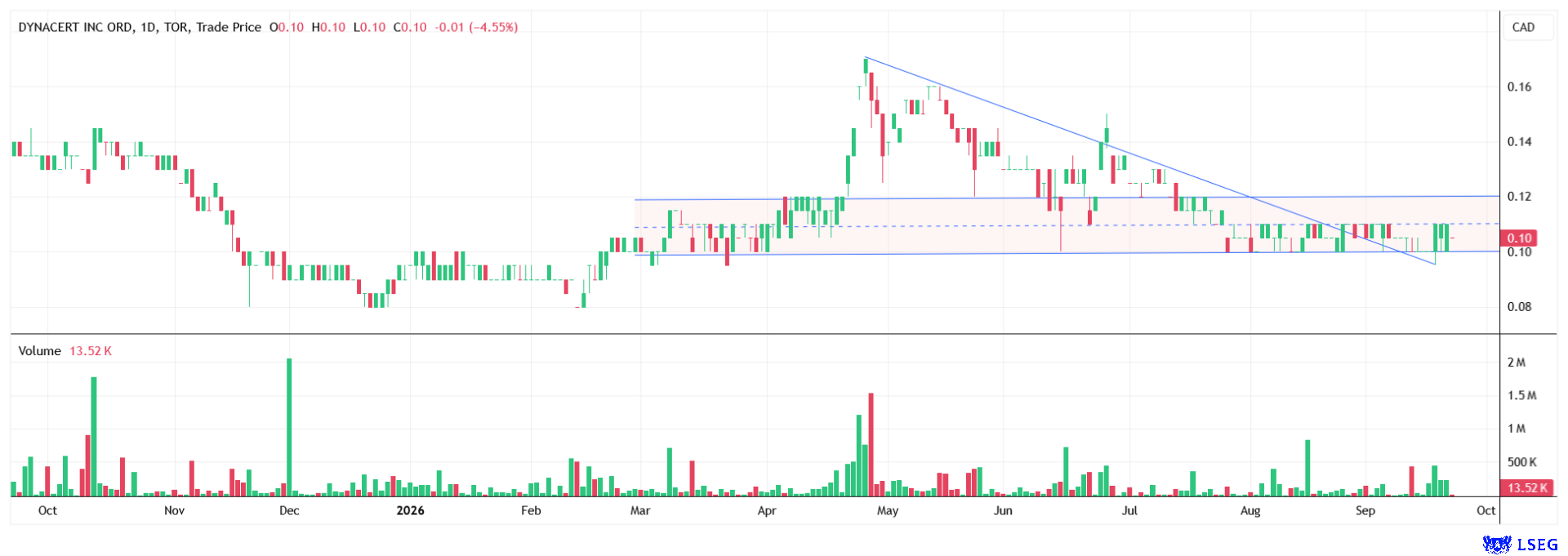
While Rheinmetall relies almost exclusively on direct defense spending, our third stock is betting on the rather quiet but unstoppable ecological transformation of vehicle and machinery fleets. The Canadian cleantech specialist dynaCERT is currently trading at around CAD 0.105 and was, or in some cases still is, trapped in a wedge formation. A dynamic breakout above the CAD 0.12 threshold could, from a purely technical perspective, quickly catapult the price toward CAD 0.15 to CAD 0.20. This technical momentum is currently being bolstered by an extremely active phase of global market expansion.
**At the core of the business model is the highly innovative HydraGEN™ technology, which can significantly reduce fuel consumption and harmful emissions from diesel engines through targeted hydrogen injection. Announcements from August 6 and 18, 2026, confirm the progress: In Vietnam, crucial pilot projects are currently underway in municipal waste management, the oil and gas industry, and the logistics sector at major port facilities. To support these tests, the company upgraded its proprietary telematics software, HydraLytica, to establish precise baselines for fleet operations.
At the same time, dynaCERT is focusing on key decision-makers in its core markets through targeted appearances at events such as IAA TRANSPORTATION in Hanover and POWERGEN 2027 in Utah.** Such direct customer contacts in the heavy-duty transportation, port operations, and stationary power generation segments are now expected to accelerate commercialization.
Investors are looking at an exciting company here that aims to make the difficult leap from being merely a promising prospect to a serious supplier. Successful Verra certification of its proprietary methodology for generating tradable CO₂ credits could provide the group with highly lucrative additional revenue in the long term.
Should the technological breakthrough in the key Asian and American markets actually materialize over the course of the coming year, the stock's current valuation is likely to be rather favorable. While entering the market at this level or after a breakout requires a willingness to take risks, it could potentially reward investors with enormous jumps in returns once the technical barriers are finally broken.
Following significant forecast cuts and a declining margin profile, Steyr Motors must first regain its operational footing; however, it remains on the radar as a turnaround play at its discounted level. Rheinmetall, on the other hand, is riding a wave of record operational performance but is currently struggling heavily with technical resistance at the stubborn EUR 1,000 mark. At dynaCERT, we view its promising environmental technology positively. The stock is currently on the verge of a potential classic breakout above CAD 0.12. The company could soon surprise the market positively with concrete global sales successes.
Conflict of interest
Pursuant to §85 of the German Securities Trading Act (WpHG), we point out that Apaton Finance GmbH as well as partners, authors or employees of Apaton Finance GmbH (hereinafter referred to as "Relevant Persons") may hold shares or other financial instruments of the aforementioned companies in the future or may bet on rising or falling prices and thus a conflict of interest may arise in the future. The Relevant Persons reserve the right to buy or sell shares or other financial instruments of the Company at any time (hereinafter each a "Transaction"). Transactions may, under certain circumstances, influence the respective price of the shares or other financial instruments of the Company.
In addition, Apaton Finance GmbH is active in the context of the preparation and publication of the reporting in paid contractual relationships.
For this reason, there is a concrete conflict of interest.
The above information on existing conflicts of interest applies to all types and forms of publication used by Apaton Finance GmbH for publications on companies.
Risk notice
Apaton Finance GmbH offers editors, agencies and companies the opportunity to publish commentaries, interviews, summaries, news and the like on news.financial. These contents are exclusively for the information of the readers and do not represent any call to action or recommendations, neither explicitly nor implicitly they are to be understood as an assurance of possible price developments. The contents do not replace individual expert investment advice and do not constitute an offer to sell the discussed share(s) or other financial instruments, nor an invitation to buy or sell such.
The content is expressly not a financial analysis, but a journalistic or advertising text. Readers or users who make investment decisions or carry out transactions on the basis of the information provided here do so entirely at their own risk. No contractual relationship is established between Apaton Finance GmbH and its readers or the users of its offers, as our information only refers to the company and not to the investment decision of the reader or user.
The acquisition of financial instruments involves high risks, which can lead to the total loss of the invested capital. The information published by Apaton Finance GmbH and its authors is based on careful research. Nevertheless, no liability is assumed for financial losses or a content-related guarantee for the topicality, correctness, appropriateness and completeness of the content provided here. Please also note our Terms of use.