November 26th, 2026 | 05:30 CET
AI, High-Tech and E-Mobility Up for Grabs! Who Makes the Best Offer for VW, Strategic Resources, BYD, Mercedes and Stellantis?
It can always go lower! The wheat has been separating from the chaff for several weeks now. At first, tech stocks still delivered sharp gains, but now profit-taking is setting in. European automotive stocks are experiencing a full-blown sell-off amid substantial earnings revisions. Investors are asking how long the downtrends will last and whether European e-mobility can ever achieve a breakthrough against its Asian competitors. In fact, actual sales figures show the industry is proving surprisingly resilient, as sales of electric cars and plug-in hybrids in Germany recently rose significantly faster than the global average. Government purchase incentives, for example in Germany, and a narrowing price gap with conventional combustion-engine vehicles are providing important tailwinds for the market. At the same time, a bitter battle to squeeze out competitors and dominate Europe's roads is raging behind these growth figures. On the stock market, e-mobility remains closely tied to the tech sector despite solid registration figures, because modern electric cars have long been seen as computers on wheels and are suffering from investors' general risk aversion. Yet even greater pressure is building on the metals supply chains that underpin the entire transition to new propulsion technologies. However, where there is risk, risk-aware investors can also find opportunities. A 7% dividend yield and share prices at five-year lows. A challenge for yield hunters!
time to read: 7 minutes | Author: André Will-Laudien
ISIN: Strategic Resources Inc | CA86277X4093 , BYD CO. LTD H | CNE100000296 , NL00150001Q9 , Volkswagen AG | DE0007664005 , Volkswagen AG | DE0007664039 , MERCEDES-BENZ GROUP AG | DE0007100000
Table of contents:
Author

André Will-Laudien
Born in Munich, he first studied economics and graduated in business administration at the Ludwig-Maximilians-University in 1995. As he was involved with the stock market at a very early stage, he now has more than 30 years of experience in the capital markets.
Tag cloud
Shares cloud
BYD – Despite fundamental strength, the share price plunges
Established European automakers are facing significant pricing and innovation pressure from aggressive Chinese manufacturers, while once-unrivalled pioneers such as Tesla are losing significant market share. European groups also face a strategic trap if, for fear of penalties, they push to water down climate targets and consequently fall behind on all-electric platforms. Chinese automaker BYD is showing fundamental strength, but its share price tells a different story, with a 37% loss for the year. What is happening in the once blue-chip electric mobility sector?
The answer lies in a ruthless phase of consolidation, where sales growth alone is no longer a free pass to high stock market valuations. BYD reported a revenue increase of around 13.6% to 221.5 billion yuan in Q3 and a 28% jump in profit to around 10 billion yuan. However, the supposedly stellar result fell well short of analysts' high expectations and was also flattered by one-off valuation gains. At least net profit fell by a modest 4.2% over the nine months, clearly overshadowing the much worse figures from European competitors. However, the figures reveal a trend: even though overseas business is still supporting the figures, a brutal price war is raging in the domestic Chinese market, noticeably eating into operating margins even at a cost leader such as BYD. In exports, Europe and the US are erecting high trade barriers with hefty punitive tariffs, which were actually intended to bolster thin domestic margins. Investors are therefore currently pricing in less the impressive technological firepower of the present than the geopolitical obstacles and dwindling profit potential of the future. So while factory production lines are running at full capacity and record numbers are rolling off the lines, investors are suddenly demanding proof of sustainable profitability rather than a pure pursuit of market share. Analysts on the LSEG Refinitiv platform are therefore also cautious: the previous price target of 150 yuan in May had fallen to just 111 yuan by autumn. Nevertheless, from the current level of 74.40 yuan, or EUR 6.70, that still represents 50% upside potential over 12 months. Speculative!
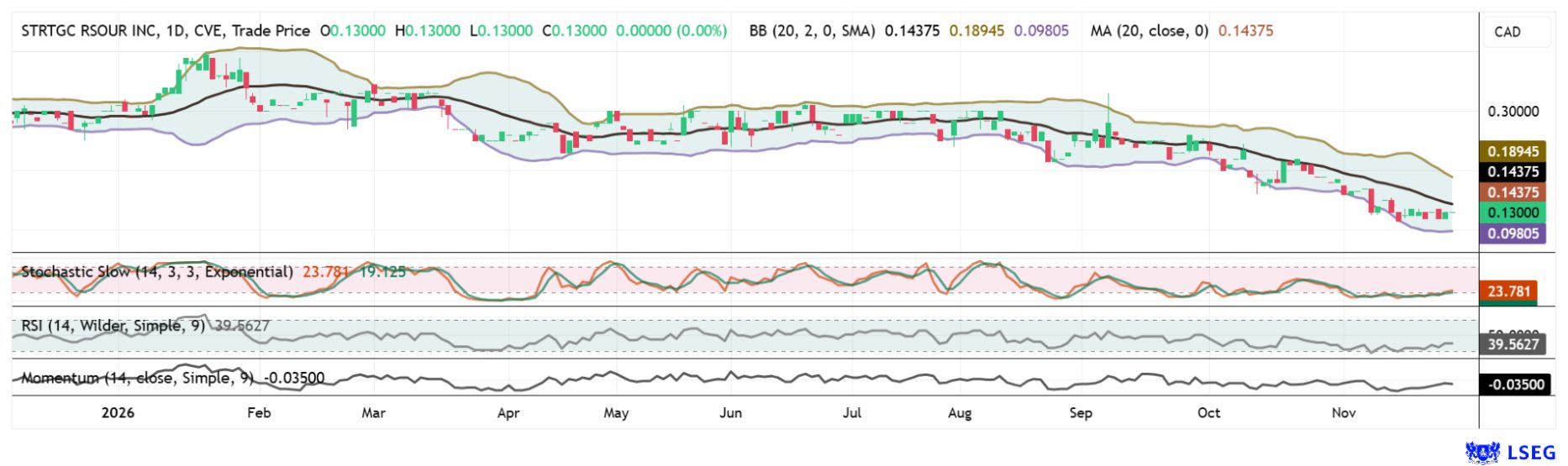
Strategic Resources – Green steel and vanadium unlock billions in potential
International automotive manufacturing remains dependent on metal supply chains. And this is the crux of the matter: the global steel industry is facing a technological transformation that could fundamentally change the market for high-purity iron ore and strategic by-product metals. Traditional blast furnace operators are increasingly under pressure from rising CO₂ costs, while electric production processes and hydrogen-based direct reduction are gaining in importance. This is where Strategic Resources is positioning itself with its BlackRock project in Québec, geared toward producing high-quality iron ore pellets for the next generation of steel production. The phased development approach is interesting: in the first phase, a pelletising plant with an annual capacity of 4 million tonnes is to be built at the deep-water Port Saguenay, initially using externally sourced ore concentrates. This allows the company to advance its entry into industrial processing without simultaneously having to shoulder the substantial investment and development risks of its own mine. The site benefits from inexpensive hydropower, an existing natural gas supply, and direct access to the St Lawrence Seaway, putting both production and international shipping in a strong strategic position.
IIF host Lyndsay Malchuk speaks to CEO Sean Cleary about the planned construction of the processing plant in Québec.
The project gains strategic importance from the tight supply situation for high-purity iron ore for direct reduction plants. Only a comparatively small proportion of the world's iron ore supply meets the relevant quality requirements, as the projected supply shortfalls could grow substantially in the coming years. With its energy and port infrastructure, Québec offers favourable conditions for establishing a foothold in this market of the future. This is complemented by substantial public investment of more than CAD 235 million in port infrastructure, including a roughly two-kilometre-long conveyor belt system from Germany's BEUMER Group. European CO₂ regulations may also shift competition in favour of lower-emission production locations. In parallel, Strategic Resources is working on obtaining approval for the first development phase and has submitted the requested data to Québec's environment ministry. This marks the completion of an important interim administrative step, although final approval and, above all, the still-outstanding financing remain the decisive prerequisites for construction to begin.
A second pillar is the wholly controlled Mustavaara project in Finland, whose vanadium-rich magnetite concentrate is now attracting considerable technological attention. The University of Oulu has selected the material for the EUR 17 million FutSteel research programme, which, together with steel group SSAB, is investigating the entire process chain of electrified and hydrogen-based steel production. The project, scheduled to run until 2029, aims to demonstrate how electric arc furnaces, modern rolling processes and lower-emission iron production can be combined on an industrial scale. For Strategic Resources, this selection is an important endorsement of quality and also opens up access to a network of research and industry. In addition, the company is working with Tyfast Energy on a Canadian vanadium value chain for novel lithium-vanadium oxide battery anodes. The focus is on applications requiring short charging times, long service life and reliable performance at low temperatures, particularly in heavy commercial vehicles, mining machinery and military systems. Given these promising approaches, the current market capitalisation of just around CAD 7.7 million remains remarkable. Market participants appear to be completely underestimating the long-term potential of the projects.
VW, Mercedes and Stellantis – Can Europe master the challenges?
For a long time, established manufacturers such as Volkswagen, Mercedes-Benz and Stellantis were regarded as the undisputed standard-setters for engineering excellence, quality and global sales strength. Yet while Europe spent years focusing on perfecting the internal combustion engine, Chinese groups used the technological turning point to stage an unprecedented catch-up. Led by industry giants such as BYD, Geely and Nio, manufacturers from the Far East had already achieved a record market share of 10.7% of new registrations in Europe in the second quarter of 2026, according to a study by Schmidt Automotive Research, overtaking all Japanese brands combined for the first time. Their decisive advantage lies in a deeply integrated value chain, ranging from their own raw material processing to low-cost mass production of battery cells. This enables Chinese manufacturers to offer their models at significantly lower prices in many cases – a critical factor, as 62% of European consumers cite the purchase price as their most important buying criterion, according to a recent Bain survey.
For VW, Mercedes and Stellantis, this creates a dangerous war on two fronts, as profits in the important Chinese market are collapsing while a fierce price war rages on their doorstep. High energy costs, complex collective bargaining structures and lengthy decision-making processes make it even harder for European groups to keep up with the rapid pace of their new competitors. Nevertheless, it would be premature to write off the old continent in the global race for the mobility of the future, especially as European electric vehicle registrations grew by an impressive 50% to over 2.2 million vehicles in the first ten months of 2026, according to the industry association ACEA. The European incumbents still have a strong foundation, particularly in chassis technology, safety standards, build quality and brand trust. Volkswagen is investing billions in new standardised platforms and, with successful models such as the Škoda Elroq and the VW ID.3, is demonstrating that the group continues to lead the German market. Mercedes-Benz is consistently focusing on technological excellence in the luxury segment in order to remain profitable through high margins and efficient electric architectures. Stellantis, in turn, is using its enormous brand diversity and flexible multi-energy platforms to respond quickly to fluctuating demand and differing customer needs. At the same time, European trade policy and new localisation strategies are giving domestic manufacturers valuable time to build their own battery factories and regional supply chains.
The Chinese market offensive is painfully forcing Europe out of its comfort zone, but it also acts as an urgently needed catalyst for radical innovation. Whether this transformation succeeds depends less on political protective barriers than on the courage of management boards to decisively break up old structures. Following repeated revisions to earnings estimates, the three protagonists' 2027 P/E ratios on the LSEG Refinitiv platform have settled at an average of 3.7 to 5.4. By historical standards, this is very cheap, but investors still need courage!
Conclusion
The electric vehicle industry has finally left its turbulent teenage years behind, and the stock market is now ruthlessly sorting out who can really cope with the tough adult world of margin pressure, tariff barriers and subdued consumer sentiment. At the same time, a substantial correction is raging in the high-tech and commodities markets after months of gains. Those who act with risk awareness and sound diversification can now find good entry levels.
Conflict of interest
Pursuant to §85 of the German Securities Trading Act (WpHG), we point out that Apaton Finance GmbH as well as partners, authors or employees of Apaton Finance GmbH (hereinafter referred to as "Relevant Persons") currently hold or hold shares or other financial instruments of the aforementioned companies and speculate on their price developments. In this respect, they intend to sell or acquire shares or other financial instruments of the companies (hereinafter each referred to as a "Transaction"). Transactions may thereby influence the respective price of the shares or other financial instruments of the Company.
In this respect, there is a concrete conflict of interest in the reporting on the companies.
In addition, Apaton Finance GmbH is active in the context of the preparation and publication of the reporting in paid contractual relationships.
For this reason, there is also a concrete conflict of interest.
The above information on existing conflicts of interest applies to all types and forms of publication used by Apaton Finance GmbH for publications on companies.
Risk notice
Apaton Finance GmbH offers editors, agencies and companies the opportunity to publish commentaries, interviews, summaries, news and the like on news.financial. These contents are exclusively for the information of the readers and do not represent any call to action or recommendations, neither explicitly nor implicitly they are to be understood as an assurance of possible price developments. The contents do not replace individual expert investment advice and do not constitute an offer to sell the discussed share(s) or other financial instruments, nor an invitation to buy or sell such.
The content is expressly not a financial analysis, but a journalistic or advertising text. Readers or users who make investment decisions or carry out transactions on the basis of the information provided here do so entirely at their own risk. No contractual relationship is established between Apaton Finance GmbH and its readers or the users of its offers, as our information only refers to the company and not to the investment decision of the reader or user.
The acquisition of financial instruments involves high risks, which can lead to the total loss of the invested capital. The information published by Apaton Finance GmbH and its authors is based on careful research. Nevertheless, no liability is assumed for financial losses or a content-related guarantee for the topicality, correctness, appropriateness and completeness of the content provided here. Please also note our Terms of use.