November 9th, 2026 | 23:05 CET
Billion-dollar opportunity in cardiac therapy: Cardiol Therapeutics, Kiniksa and Novo Nordisk
Created and Published on Behalf of Cardiol Therapeutics
The treatment of inflammatory heart diseases is becoming one of the most lucrative segments of the pharmaceutical industry. The only drug approved to date for recurrent pericarditis is expected to exceed USD 1 billion in revenue this year. While established industry heavyweights generate enormous revenues from injectable biologics, emerging biotechnology companies are preparing the next stage of development. The focus is on the search for oral therapies intended to open up access to treatment for a much broader patient population.
time to read: 4 minutes | Author: Nico Popp
ISIN: Cardiol Therapeutics Inc | CA14161Y2006 , Kiniksa Pharmaceuticals International | GB00BRXB0C07 , NOVO NORDISK A/S | DK0062498333
Table of contents:
Author

Nico Popp
At home in Southern Germany, the passionate stock exchange expert has been accompanying the capital markets for about twenty years. With a soft spot for smaller companies, he is constantly on the lookout for exciting investment stories.
Tag cloud
Shares cloud
High disease burden drives demand in the healthcare system
To put the need for new active compounds into context, it is worth looking at the disease burden: recurrent pericarditis is characterised by extreme chest pain due to inflammatory flare-ups of the pericardium – the sac around the heart. Around 30% of patients with an initial acute episode experience a relapse within 18 months, with many of them suffering from multiple, recurring flare-ups. A retrospective analysis of data from privately insured patients in the US revealed drastic cost differences, with direct healthcare costs for patients with multiple relapses amounting to USD 2,728 per month (Lin et al., Advances in Therapy, 2021). The main cost drivers are expensive inpatient hospital stays. As the condition also accounts for around 5% of all emergency department visits for non-ischaemic chest pain in North America and Western Europe, it puts pressure on healthcare systems. Targeted therapies that prevent these recurrences and the associated hospitalisations are therefore also considered important from a health economics perspective.
Kiniksa and Regeneron: The billion-dollar breakthrough with Arcalyst
The US biotech group Regeneron developed the active substance rilonacept. Kiniksa Pharmaceuticals secured approval for Arcalyst for recurrent pericarditis, markets it and shares profits equally with Regeneron. The drug made Kiniksa highly profitable. At the end of October, Kiniksa reported a revenue jump of around 58% to USD 286 million for the third quarter and raised its full-year guidance to up to USD 1.05 billion. This rapid market penetration illustrates the considerable commercial potential, even though, according to the company, only around 23% of the estimated 14,000 US patients with multiple relapses each year currently receive this therapy. High list prices of over USD 300,000 a year and the need for weekly injections have so far limited broader use in patients with less severe disease.
Novo Nordisk: Setback in systemic inflammation inhibition
The significant risks involved in developing anti-inflammatory heart therapies were recently demonstrated at Danish pharmaceutical giant Novo Nordisk. In the summer, Novo Nordisk's anti-inflammatory drug ziltivekimab completely missed the primary endpoint of the large-scale ZEUS trial, as the active compound provided no clinical benefit in reducing cardiovascular events. This failure demonstrates the challenge of targeting inflammation in cardiovascular disease. In September, Novo Nordisk also discontinued two ziltivekimab trials in heart failure following an interim analysis, as no success was apparent. Only the ARTEMIS trial in patients following a heart attack remains ongoing, with results expected in 2027.
However, according to Cardiol, the enthusiasm for targeting inflammation and inflammasome pathway activation in heart diseases has not dampened. The underlying biology and evidence are strong and there is no indication that Big Pharma is walking away from either the core hypothesis or their commitment to programs targeting the inflammatory pathway. The sweet-spot for targeting inflammation and optimising the benefit-risk in heart disease may lie with drugs that are targeting inflammation pathways further upstream (such as CardiolRx™) rather than targeting a single downstream cytokine like IL-6.
Cardiol Therapeutics: Challenger at a pivotal stage
Cardiol Therapeutics: Challenger at a pivotal stage
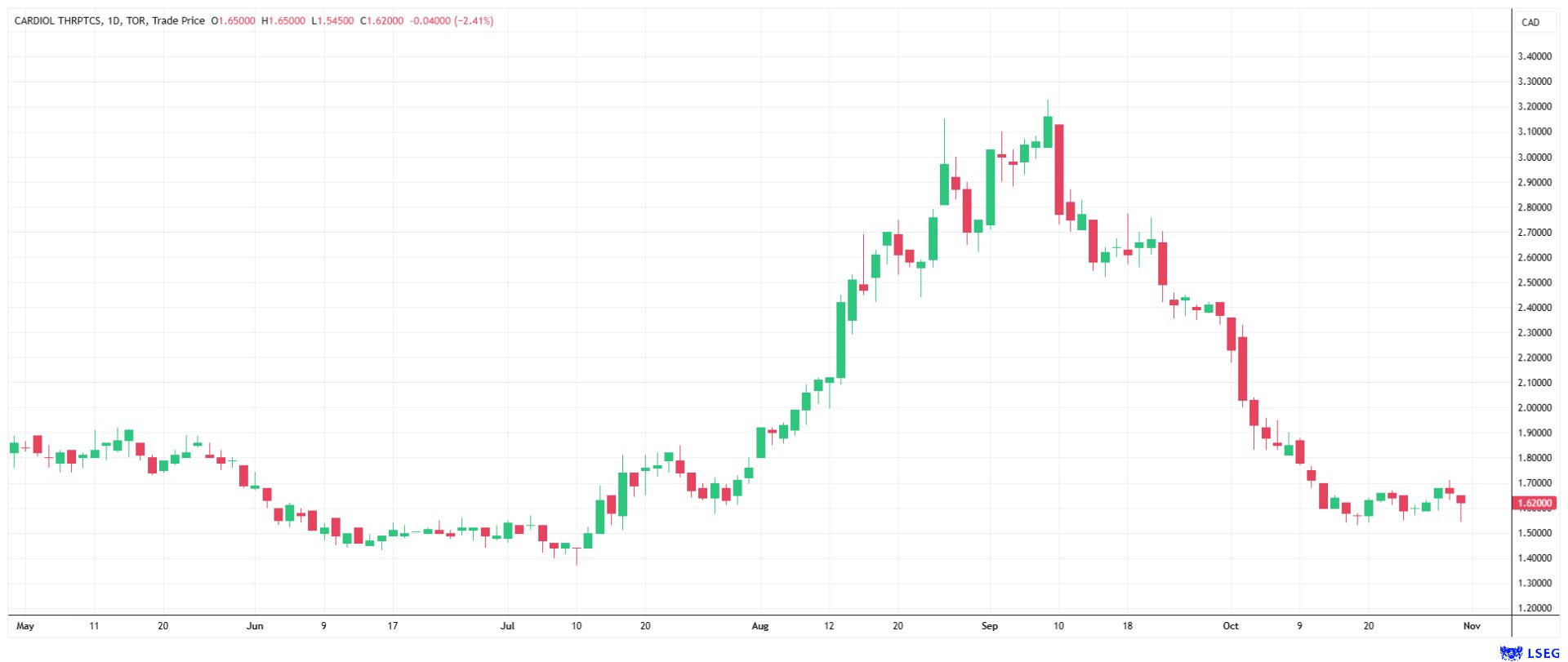
Against this backdrop, Cardiol Therapeutics is positioning its lead product candidate, CardiolRx™, as a direct challenger to the existing standard of care in recurrent pericarditis. Unlike injectable biologics, CardiolRx™ is an oral drug solution that specifically dampens a central inflammatory mechanism in the body without, as indicated by safety data from two Phase II clinical trials, fundamentally suppressing the immune system. In September, Cardiol Therapeutics reached its recruitment target of 110 patients in the pivotal MAVERIC Phase III trial ahead of schedule and subsequently expanded the cohort to up to 150 participants. This expansion was based on a blinded data review, which showed fewer relapses overall than expected. Management sees this as an encouraging signal; the analysis of the unblinded data is still pending. The trial design allows patients previously stable on IL-1 blocker injections to switch to oral therapy or a placebo. The increase in the patient population means that the release of top-line trial results will be delayed slightly until the middle of next year. The clinical data from the previous open-label Phase II MAvERIC-Pilot study had already shown a profound reduction in pain and a significant reduction in pericarditis relapses.
Solid financial base and protection from competitors
The delay in publishing the data does not pose an existential financial threat to Cardiol Therapeutics. According to the company, available cash is expected to be sufficient to fund operations, including completion of the MAVERIC trial, into the first quarter of 2028. This mitigates the immediate risk of dilution through capital measures ahead of the key data readout. In parallel, the US Patent Office has granted the company broad patents intended to protect the active substances in several cardiac indications through October 2040. The strong interest in oral anti-inflammatory drugs for the heart was illustrated at the start of the year by Eli Lilly's acquisition of Ventyx for USD 1.2 billion. However, competing oral approaches such as that of Ventyx are still in Phase II, giving Cardiol Therapeutics a head start.
Conclusion: The realignment of the billion-dollar market
The market for recurrent pericarditis potentially faces a paradigm shift if Cardiol Therapeutics can successfully challenge the injection-based immunosuppressive treatments with its oral therapy. Approval would enable cardiologists to treat the just over three-quarters of patients with multiple relapses who are not yet receiving IL-1 blocker therapy. As a development-stage company, Cardiol Therapeutics does not yet generate regular revenue, and its path forward depends largely on the MAVERIC data; shares therefore remain a speculative investment. Nevertheless, the unmet medical need offers a significant opportunity if the drug meets high expectations in the coming year.
Conflict of interest
Conflicts of interest
This article is an advertisement and has been produced and published by Apaton Finance GmbH (“Apaton”) on behalf of Cardiol Therapeutics Inc. (the “Issuer”). For these services, Apaton receives compensation from the Issuer in the amount of EUR 1,000.
The author of this article reserve the right, following publication of this article, to purchase and subsequently sell shares or other financial instruments of the Issuer at any time and thereby speculate on rising or falling prices. Such purchases and sales may, in certain circumstances, affect the market price of the Issuer’s shares or other financial instruments.
At the time of publication of this article or, in the event of a subsequent material update, at the time of such update, the following person(s) hold shares in the Issuer: Apaton’s managing director and Apaton’s parent company. The person(s) identified above may benefit from movements in the market price. The author of this article, Apaton’s managing director and Apaton’s parent company reserve the right, following publication or any material update of this article, to purchase shares or other financial instruments of the Issuer and to sell them again at any time in order to benefit from movements in the market price. Such purchases and sales may, in certain circumstances, affect the market price of the Issuer’s shares or other financial instruments.
This article should not be understood as independent or neutral journalistic reporting. Readers should therefore assess the information and opinions presented in light of the circumstances disclosed above.
Further notices
The information contained in this article is based on careful research. Nevertheless, no liability is accepted for financial losses, nor is any guarantee given as to the timeliness, accuracy, appropriateness or completeness of the information provided. Neither any regulatory authority nor any stock exchange or other market on which financial instruments of the Issuer are traded has reviewed or endorsed this article. Investment decisions should never be based solely on the information contained in this article, but should take into account a variety of information sources, including the Issuer’s website and other official sources.
This article does not constitute any express or implied invitation to act, recommendation or offer to purchase shares or other financial instruments of the Issuer. No assurance is given as to any particular development of market prices. This article is not a substitute for individual professional investment advice.
To the extent that this article contains forward-looking statements, such statements may be identified in particular by terms such as “expects”, “plans” or “potential” and may relate, for example, to future business and corporate developments, operational or strategic objectives, projects, products or services, market and revenue developments, financings or other future events. Forward-looking statements are based on current assumptions and expectations and are subject to known and unknown risks and uncertainties. Actual developments and results may therefore differ materially from such statements. Undue reliance should not be placed on forward-looking statements.
Please refer to our Terms of Use.
Risk notice
Apaton Finance GmbH offers editors, agencies and companies the opportunity to publish commentaries, interviews, summaries, news and the like on news.financial. These contents are exclusively for the information of the readers and do not represent any call to action or recommendations, neither explicitly nor implicitly they are to be understood as an assurance of possible price developments. The contents do not replace individual expert investment advice and do not constitute an offer to sell the discussed share(s) or other financial instruments, nor an invitation to buy or sell such.
The content is expressly not a financial analysis, but a journalistic or advertising text. Readers or users who make investment decisions or carry out transactions on the basis of the information provided here do so entirely at their own risk. No contractual relationship is established between Apaton Finance GmbH and its readers or the users of its offers, as our information only refers to the company and not to the investment decision of the reader or user.
The acquisition of financial instruments involves high risks, which can lead to the total loss of the invested capital. The information published by Apaton Finance GmbH and its authors is based on careful research. Nevertheless, no liability is assumed for financial losses or a content-related guarantee for the topicality, correctness, appropriateness and completeness of the content provided here. Please also note our Terms of use.